

TB-500 Storage: A Lab-Grade Guide for US Researchers
Lyophilized TB-500 belongs in the freezer at -20°C for long-term preservation, or at 2–8°C if your lab will use it within months. Once reconstituted with bacteriostatic water (BAC water), store it at 2–8°C and use it within approximately 28 days. These are the two rules that govern every TB-500 storage decision in a preclinical research setting.
Core handling rules at a glance:
- Lyophilized, long-term: -20°C, airtight secondary packaging with desiccant, protected from light
- Lyophilized, medium-term: 2–8°C, up to a medium-term period depending on lot-specific stability data
- Reconstituted with BAC water: 2–8°C, use within about 28 days; do not freeze
- Reconstituted with sterile water: 2–8°C, use within about 24 hours
- Never freeze a reconstituted solution: freeze-thaw cycles can reduce potency or cause aggregation
- Label every vial at reconstitution with date, concentration, and initials
- Verify the Certificate of Analysis (COA) before use; HPLC and mass spectrometry results confirm purity and identity
Neolabpeptides supplies TB-500 in lyophilized form with lot-level COAs and third-party HPLC/mass spectrometry verification, which gives your lab the documentation baseline these protocols require.
Key Takeaways
Correct TB-500 storage requires matching the storage temperature to the peptide’s physical state and intended use window, with COA-backed documentation at every step.
| Point | Details |
|---|---|
| Lyophilized storage temperatures | Freeze at -20°C for a long-term period of about two to three years; refrigerate at 2–8°C for a medium-term period of about one to two years; room temperature for transit only. |
| Reconstituted shelf life | BAC water: about 28 days at 2–8°C; sterile water: about 24 hours at 2–8°C; never freeze reconstituted solutions. |
| Freeze-thaw and aliquoting | Prepare single-use aliquots before freezing; each aliquot thaws once and is discarded to prevent potency loss. |
| Degradation and QC checks | Discard any vial showing turbidity, particulates, color change, or sticky powder; confirm purity via COA, HPLC, or MS. |
| Neolabpeptides | Supplies lyophilized TB-500 with lot-level COAs and HPLC/MS verification above 98% purity, shipped within the US. |
Table of Contents
- Detailed TB-500 storage conditions by state and time horizon
- How to reconstitute TB-500 correctly
- Recognizing TB-500 degradation before it affects your data
- Handling temperature excursions and shipping TB-500 safely
- QC practices and documentation for traceable TB-500 research
- How Neolabpeptides supports research-grade TB-500 traceability
- Practical habits that reduce TB-500 storage risk in daily lab work
- Research-grade TB-500 with full documentation, shipped across the US
- Sources
Detailed TB-500 storage conditions by state and time horizon
Lyophilized peptides are most stable when kept at 4°C or colder, in a cool, dry, dark environment. For TB-500 specifically, common supplier guidance places freezer storage at -20°C for a long-term period of about two to three years, refrigerated storage at 2–8°C for a medium-term period of about one to two years, and room temperature as acceptable only for short shipping windows.
Lyophilized TB-500 storage by temperature:
| Storage State | Temperature | Estimated Shelf Life |
|---|---|---|
| Frozen (long-term) | -20°C | a long-term period of about two to three years |
| Refrigerated (medium-term) | 2–8°C | a medium-term period of about one to two years |
| Room temperature | 20–25°C | Short transit only |
| Reconstituted, BAC water | 2–8°C | about 28 days |
| Reconstituted, sterile water | 2–8°C | about 24 hours |
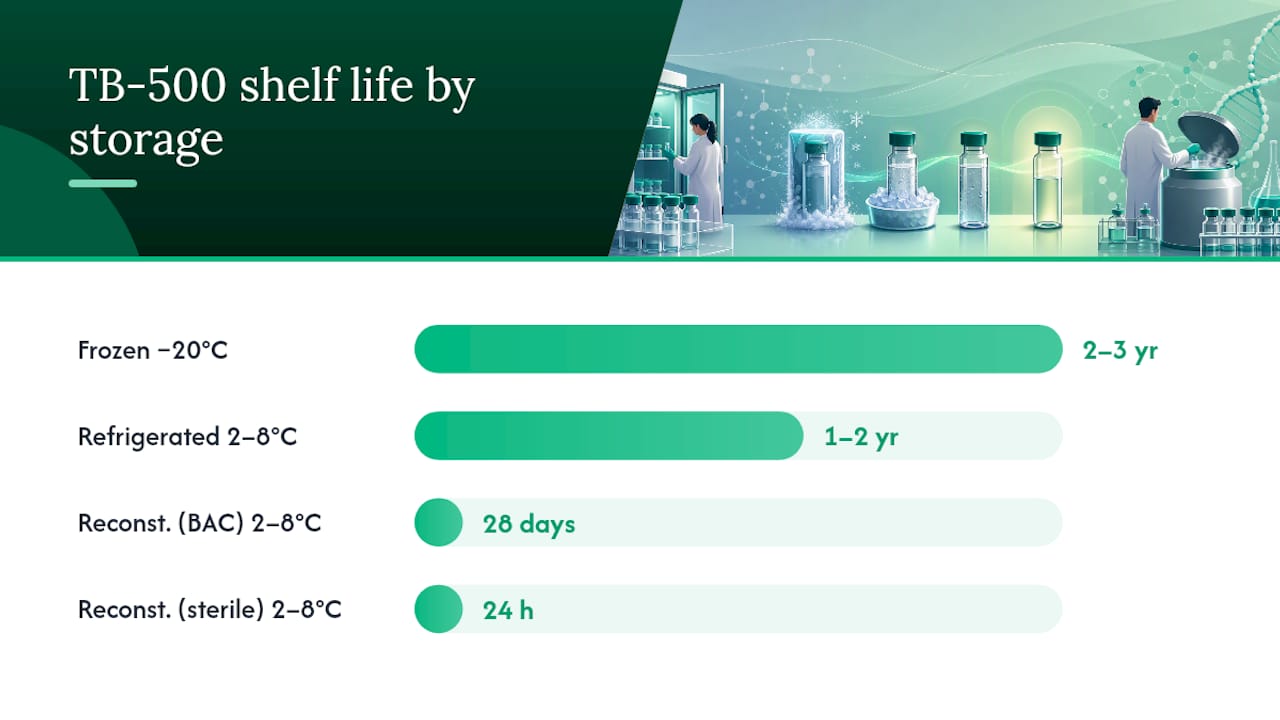
Shelf-life ranges reflect common supplier guidance. Always defer to the lot-specific COA and your supplier’s published stability data.
Environmental controls that matter:
- Store lyophilized vials in airtight secondary containers with silica gel desiccant; moisture ingress is one of the fastest routes to degradation
- Protect all forms from direct light; photodegradation is a documented risk for peptides, and amber or opaque secondary packaging addresses it
- Short ambient exposures during shipping are generally acceptable for lyophilized material, but reconstituted solutions should never travel unrefrigerated
- Do not store reconstituted vials in the refrigerator door; temperature fluctuates there with every opening
Pro Tip: Place lyophilized vials at the back of the freezer shelf, away from the door seal. That position experiences the least temperature variation during routine access and avoids the brief warming that occurs each time the door opens.
How to reconstitute TB-500 correctly
Use bacteriostatic water for any vial that will be accessed more than once over multiple days. Sterile water is acceptable for single-use preparations, but the in-use window drops to roughly 24 hours.
Step-by-step reconstitution protocol:
- Swab the vial septum with a 70% isopropyl alcohol wipe and allow it to dry completely before puncturing.
- Draw the calculated volume of BAC water into a sterile syringe.
- Insert the needle at an angle and direct the solvent slowly down the inner wall of the vial. Do not spray it directly onto the lyophilized cake.
- Swirl gently until the powder dissolves. Never vortex; mechanical agitation can denature the peptide.
- Inspect the solution for clarity. It should be colorless and free of particulates.
- Label the vial immediately: date of reconstitution, concentration in mg/mL, lot number, and your initials.
- Transfer to 2–8°C storage within 30 minutes of reconstitution.
Concentration example: Adding 2.0 mL of BAC water to a 5 mg vial yields approximately 2.50 mg/mL. On a U-100 insulin syringe, each 10 IU graduation equals 100 µL, so 100 IU delivers 250 µg; for example, a 2.5 mg (2,500 µg) research dose corresponds to 100 IU on that scale. Always verify your syringe calibration against your target concentration before drawing.
Aliquoting to avoid freeze-thaw damage:
If your protocol requires frozen storage of prepared material, aliquot into single-use volumes before freezing. Use sterile cryovials labeled with lot, concentration, and date. Each aliquot is thawed once and discarded after use. Limit freeze-thaw cycles to one per aliquot; freeze-thaw cycles can reduce potency or cause aggregation, which compromises experimental reproducibility.
Pro Tip: Pre-chill your BAC water to 4°C before reconstitution. Cold solvent reduces local heating at the point of contact with the lyophilized cake, which can help preserve peptide integrity during dissolution, particularly for larger vial sizes.
Recognizing TB-500 degradation before it affects your data
Realistic shelf-life windows depend on storage conditions and lot-specific stability. Lyophilized TB-500 stored at -20°C typically remains viable for a long-term period of about two to three years; at 2–8°C, expect a medium-term period of about one to two years. Reconstituted material with BAC water is generally considered stable for up to 28 days at 2–8°C; with sterile water, that window is approximately 24 hours.
Several factors accelerate degradation faster than temperature alone:
- Heat excursions: even brief exposure above 25°C can initiate structural changes in the peptide
- Moisture ingress: compromised vial seals or improper secondary packaging allow humidity to reach the lyophilized powder
- Repeated freeze-thaw: each cycle stresses the peptide’s tertiary structure
- Light exposure: UV and visible light can break peptide bonds over time
- Contamination during puncture: non-sterile technique introduces microbial load that degrades the solution
Visual and physical signs that a vial should be discarded:
- Turbidity or cloudiness in a reconstituted solution that was previously clear
- Visible particulates or flocculation
- Color change from colorless to yellow or brown
- Lyophilized powder that appears sticky, clumped, or has changed texture
- Any unusual odor upon reconstitution
When any of these signs appear, quarantine the vial, document the observation with date and lot number, and do not use the material. If the finding is unexpected given proper storage, contact your supplier and request a review of the lot-level COA. For critical studies, HPLC purity confirmation or mass spectrometry identity verification provides objective evidence before a use-or-discard decision.
Decision rule: If visual inspection passes but you have any doubt about storage history, quarantine and test. A failed HPLC run costs far less than a compromised dataset.
Handling temperature excursions and shipping TB-500 safely
Temperature excursions during transit are one of the most common sources of unplanned degradation in research peptide workflows. The response protocol matters as much as the packaging.
When you suspect an excursion has occurred:
- Quarantine the affected lot immediately; do not distribute to bench use until the situation is assessed
- Document the estimated time and temperature of exposure as precisely as possible
- Inspect each vial: check for vial integrity, powder appearance, and any signs of moisture condensation inside the vial
- Contact your supplier with the lot number and excursion details; request their stability guidance for that specific lot
- Review the COA for the affected batch before making a use-or-discard decision
Shipping best practices for lyophilized TB-500:
- Use insulated shippers with cold packs rated for the expected transit duration
- Do not allow cold packs to contact vials directly; a layer of bubble wrap or foam prevents localized freezing at the vial surface
- Label packages clearly as “research samples” and include the COA and storage instructions inside the shipment
- Reputable vendors include cold packs during warm-weather shipping to maintain acceptable transit temperatures for lyophilized material
Pro Tip: For inter-lab transfers of reconstituted TB-500, use a validated insulated carry bag with a calibrated temperature data logger. A logged temperature record protects both the material and your experimental documentation if a question arises later.
Receiving checklist for incoming TB-500 shipments:
- Inspect outer packaging for damage or signs of temperature compromise
- Verify vial integrity, powder appearance, and label information (lot number, COA reference)
- Record arrival temperature and the time of receipt in your inventory log
- Cross-reference the lot number against the COA provided with the shipment before placing the vial into storage
QC practices and documentation for traceable TB-500 research
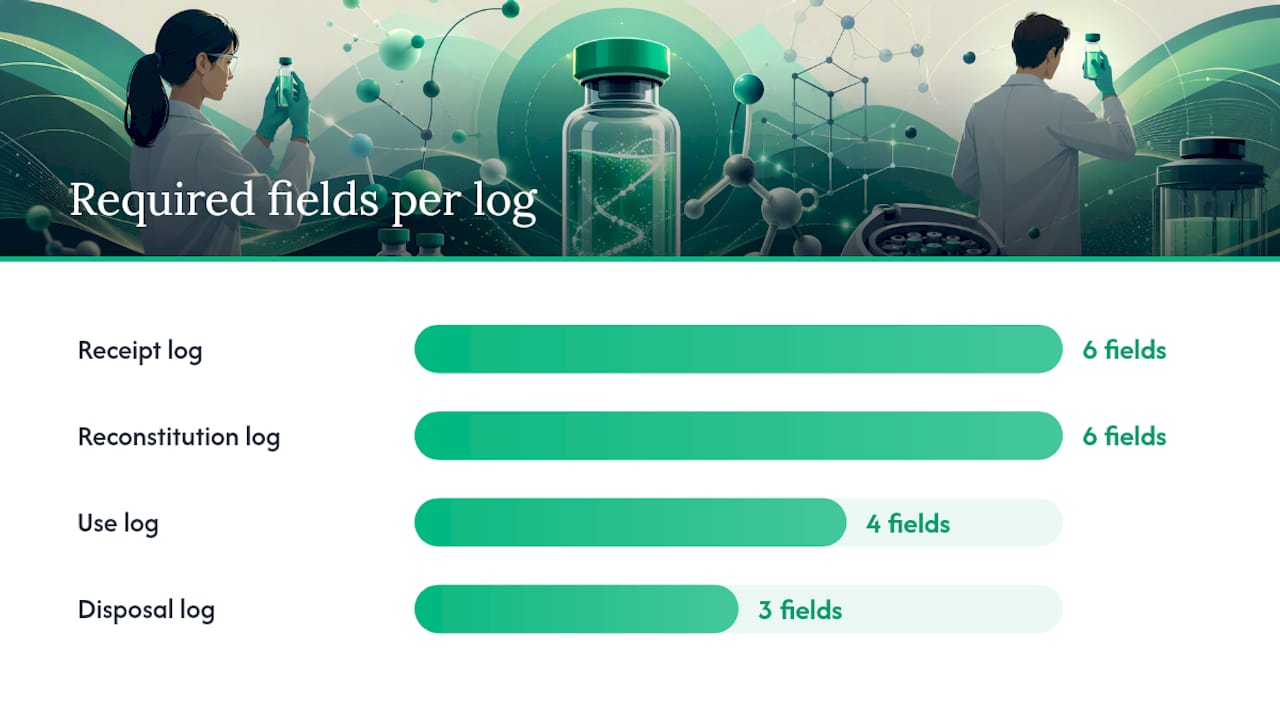
Traceability in preclinical work is not optional. Every vial of TB-500 used in a study should be traceable back to a specific lot, COA, and storage record. The minimum documentation set for a US research lab includes:
- Receipt log: date received, supplier, lot number, COA reference, arrival temperature, storage location assigned
- Reconstitution log: date, lot number, solvent used, volume added, resulting concentration, technician initials
- Use log: date of each use, volume withdrawn, experiment or sample ID, remaining volume estimate
- Disposal log: date discarded, reason (expired, degraded, contaminated), method of disposal
Third-party testing documentation is the foundation of this system. A COA from a qualified supplier will include HPLC purity data and mass spectrometry identity confirmation. Review the HPLC chromatogram for a single dominant peak at the expected retention time; a fragmented or shifted profile suggests degradation or impurity. Mass spectrometry confirms molecular identity by matching the observed mass to the theoretical mass of TB-500 (Thymosin Beta-4, MW approximately 4,963 Da).
Label every vial with a unique internal inventory code that links to your lab’s electronic or paper records. That code connects the physical vial to the experiment metadata, so any result can be traced to the specific material used.
“Supplier stability notes typically give a range; use the supplier’s lot-level COA and any published stability data as the definitive source for a given vial rather than relying solely on generic guidance.” FormBlends TB-500 Storage Guide
Neolabpeptides provides lot-level COAs with HPLC and mass spectrometry results for every TB-500 batch. Labs can access that documentation directly from the product page, which supports the receipt and QC logging steps above without requiring additional third-party testing for routine use. For GMP-aligned quality criteria, the COA should confirm purity at or above 98%.
How Neolabpeptides supports research-grade TB-500 traceability
That documentation structure directly supports the receipt, QC, and traceability workflows described throughout this guide.
Practical services relevant to lab buyers:
- Lot-level COAs available at the point of purchase, with HPLC chromatograms and MS identity data
- US shipping that minimizes transit time and reduces temperature-excursion risk compared with international sourcing
- Product storage notes included with each order to support correct handling from the moment of receipt
- Customer support for temperature-excursion questions and COA review when a shipment concern arises
For labs evaluating TB-500 for preclinical research, the availability of batch-specific documentation is the single most important supplier criterion after purity. Generic certificates that apply to a product category rather than a specific lot provide no traceability value.
All TB-500 products from Neolabpeptides are supplied for research use only and are not approved for human or veterinary administration.
Pro Tip: When placing an order, request the COA for the specific lot you will receive before the shipment ships. Cross-referencing the lot number on arrival against the pre-shipment COA confirms you received the tested material.
Practical habits that reduce TB-500 storage risk in daily lab work
The protocols above are only as reliable as the habits that implement them. A few structural choices make a measurable difference in peptide stability across a research team.
Assign reconstitution responsibility to a single designated person per project, at least for the initial setup of each vial. Distributed reconstitution across multiple team members without a standardized SOP is the most common source of inconsistent concentrations and undocumented handling events. A one-page reconstitution SOP posted at the bench eliminates most of those errors.
Weekly freezer and refrigerator temperature checks should be logged, not just observed. A calibrated min-max thermometer or a continuous data logger catches door-seal failures and compressor issues before they affect stored material. For small labs, a simple paper log works; larger core facilities benefit from automated monitoring systems with email alerts.
Align your aliquoting strategy with your experiment schedule. If a study requires weekly dosing over four weeks, prepare four single-use aliquots at reconstitution rather than drawing repeatedly from one vial. That approach eliminates repeated puncture risk and keeps the remaining aliquots frozen until needed.
For small labs with limited freezer space, prioritize the back of the lowest shelf for TB-500 vials. Larger core facilities should assign a dedicated peptide storage zone with restricted access and a separate temperature log. In both cases, an inventory alert set at 30 days before the reconstitution expiry date prevents inadvertent use of out-of-window material.
Periodic COA review against stored lots, at least quarterly, confirms that the documentation on file matches the physical inventory. Any discrepancy between a vial’s label and the COA on record should trigger a quarantine and investigation before that vial is used in a study.
Research-grade TB-500 with full documentation, shipped across the US
Labs that need COA-verified, HPLC-confirmed TB-500 without the delays of international sourcing have a direct option. Neolabpeptides delivers research-grade TB-500 (Thymosin Beta-4) in lyophilized form with lot-specific COAs, third-party purity verification above 98%, and US shipping that keeps transit times short and temperature-excursion risk low.

Every order includes the batch documentation your lab needs to complete receipt logs, reconstitution records, and traceability chains from the first day of a study. For labs that have worked through the storage and QC protocols in this guide, Neolabpeptides provides the supplier-side documentation that makes those protocols function. Visit the TB-500 product page to review current lot availability, access COA documentation, and place an order for your next research cycle. All products are for research use only and are not approved for human or veterinary use.
Sources
The guidance in this article draws on the following sources. Lab staff are advised to verify lot-specific COAs and supplier stability statements for every purchase, as published ranges reflect general guidance rather than lot-level data.
- Peptide Handling, dissolution & Storage
- TB-500 Storage Instructions: Complete Guide | FormBlends
- TB-500 Reconstitution: 5mg + 2mL Chart (2026) | The Peptide Catalog
All products referenced in this article are for research use only and are not approved for human or veterinary administration. This article provides general laboratory guidance and does not substitute for professional scientific or regulatory advice. Confirm current stability data and handling requirements with your supplier and applicable institutional protocols.
This article is general information, not a substitute for advice from a qualified doctor. Consult a qualified healthcare professional about your own circumstances before acting on anything here.