

Shipping Research Chemicals US: Compliance Guide
Yes, qualified researchers, laboratories, and commercial buyers can purchase and ship research chemicals within the United States, provided the shipment satisfies U.S. Department of Transportation (DOT) rules under 49 CFR, meets EPA/TSCA import requirements when the material crosses a border, and matches the carrier’s own hazmat policies. The compliance burden falls mostly on documentation, not on the chemistry itself.
Before you place an order, verify three things:
- The supplier can provide a Safety Data Sheet (SDS), a lot-specific Certificate of Analysis (COA), and a written “research use only” statement.
- The package’s DOT shipping classification is either exempt under Limited Quantity provisions or properly declared as hazmat.
- Your chosen carrier, whether FedEx, UPS, DHL, or USPS, actually accepts that chemical class to your delivery ZIP code.
Skip any one of these checks and you risk a rejected shipment, a customs hold, or a compliance flag at your own institution.
Key Takeaways
Compliant shipping of research chemicals in the U.S. depends on matching DOT transport rules, EPA/TSCA import status, and carrier hazmat policy before you place the order, not after.
| Point | Details |
|---|---|
| Two regulatory tracks apply | DOT 49 CFR governs transport; EPA/TSCA governs whether a chemical can legally enter U.S. commerce. |
| Documentation prevents rejection | Lot-specific COA and matching SDS are the most common reason shipments clear or get refused at receiving. |
| Limited Quantity saves money | Containers near a quart or liter often avoid hazmat paperwork and surcharges under 49 CFR § 173.150. |
| Vet suppliers before ordering | Confirm COA, third-party testing, and itemized hazmat fees before submitting a purchase order. |
| Choose documented sourcing | Neolabpeptides provides lot-specific COAs, third-party HPLC/MS testing, and U.S. shipping with SDS available on request. |
Table of Contents
- What Federal Laws Govern Shipping Research Chemicals in the US?
- Which Carriers Accept Research Chemical Shipments?
- What Documentation and Labeling Does a Shipment Need?
- How Does the DOT Limited Quantity Exemption Work?
- How Do You Choose a Compliant Research Chemical Supplier?
- Step-By-Step: Buying and Shipping Research Chemicals in the US
- What Red Flags Signal a Non-Compliant Supplier?
- Where to Buy Research Peptides With Verified Documentation
- Frequently Asked Questions
- Sources
What Federal Laws Govern Shipping Research Chemicals in the US?
Two separate regulatory tracks apply, and conflating them is the most common mistake procurement teams make. Transport falls under DOT’s Hazardous Materials Regulations in 49 CFR, which dictate packaging, labeling, and carrier handling regardless of where the chemical came from. Import and market access falls under the EPA’s Toxic Substances Control Act (TSCA), which governs whether a substance can legally enter U.S. commerce at all.
EPA guidance is explicit that import certification requirements apply to substances received by mail or commercial carrier, including those destined for research and development. Ordering “for research only” does not exempt you from certifying compliance at the border. Before importing, check whether your substance appears on the TSCA Inventory, the EPA’s official list of chemicals cleared for U.S. commerce. If it’s not listed, premanufacture notice requirements under 40 CFR Part 720 may apply.
Commercial import filings run through U.S. Customs and Border Protection’s Automated Commercial Environment (ACE), the electronic system CBP uses to process customs entries. For anything beyond a routine domestic order, involve a customs broker early.
- Domestic transport: DOT 49 CFR
- Import/market access: EPA/TSCA
- Customs filing: CBP via ACE
If your order touches a controlled precursor, a scheduled substance, or a state-specific restriction, loop in your institution’s EHS office or legal counsel before you submit the purchase order.
Which Carriers Accept Research Chemical Shipments?
Carrier policy often decides your shipping method faster than the regulation does. FedEx, UPS, and DHL each accept many research chemicals, but their tolerance depends heavily on container size and DOT classification.
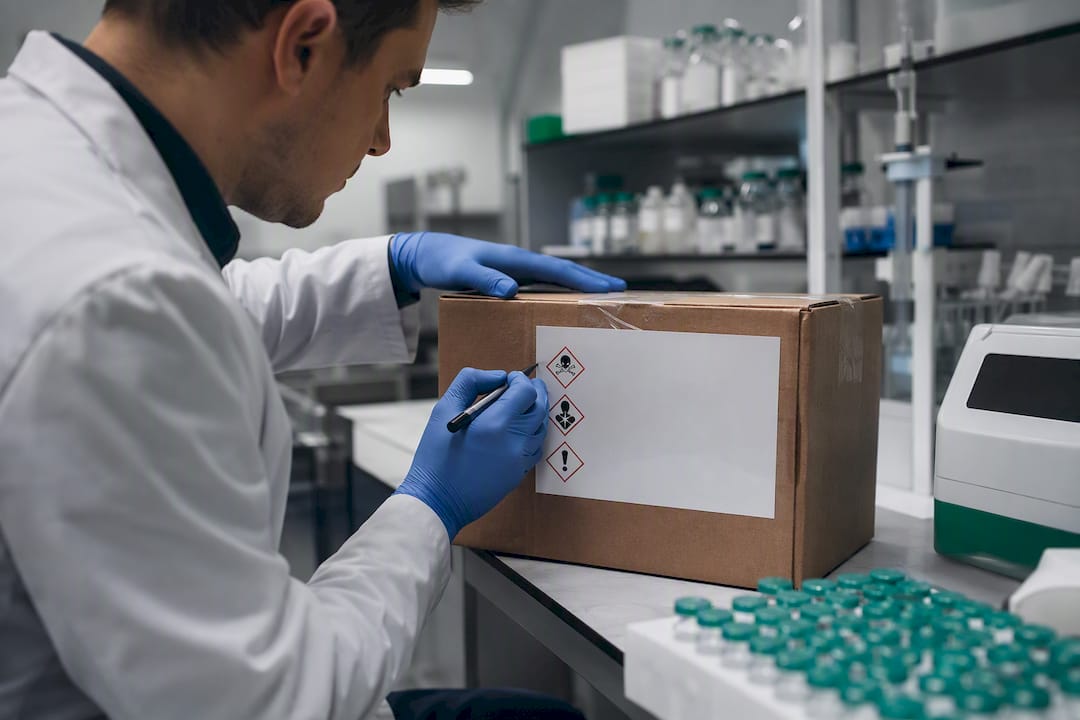
Small containers that qualify for DOT’s Limited Quantity exemption typically move through standard air or ground parcel networks with minimal friction. Anything reclassified as full hazmat, on the other hand, usually loses air eligibility and shifts to ground-only service, sometimes adding one to three days to transit.
Common carrier requirements you’ll encounter:
- Accurate proper shipping name and UN number on regulated shipments
- UN-spec packaging for anything crossing the hazmat threshold
- Driver hazmat certification for pickup and delivery of classified freight
- Destination restrictions on certain reactive or flammable materials, and LTL-only handling for drums or totes
USPS applies its own, generally stricter, hazardous materials mailing standards and rejects many chemical categories outright, so most commercial shipments move through FedEx, UPS, or DHL instead.
Pro Tip: Ask your supplier for an itemized shipping and hazmat fee breakdown before checkout. A quote that just says “shipping: calculated” often hides a $40 to $150 hazmat surcharge that only shows up after you’ve committed to the order.
What Documentation and Labeling Does a Shipment Need?
Receiving docks reject shipments over paperwork far more often than over the chemical itself. Institutional EHS guidance from Brown University notes that missing or mismatched SDS and COA documentation is one of the most common reasons labs refuse a delivery outright.
Build your documentation checklist around these four items:
- Safety Data Sheet (SDS) matching the exact product and lot
- Certificate of Analysis (COA) tied to that specific lot number, not a generic product-line COA
- Commercial invoice for any international shipment, plus TSCA import certification where applicable
- Correct labeling: proper shipping name, hazard class, UN number, and a visible Limited Quantity mark when the package qualifies
Packaging needs to match what the SDS specifies, meaning UN-spec outer packaging for hazardous materials, absorbent inner packaging for liquids, and inner containment sized appropriately for the volume. Ask suppliers to attach the batch-matching COA and a digital SDS directly to the order confirmation email rather than promising to “send it separately.” That single habit prevents most receiving-dock delays.
How Does the DOT Limited Quantity Exemption Work?
DOT’s Limited Quantity provision, found at 49 CFR § 173.150, generally exempts containers holding roughly a quart or a liter or less from full hazmat paperwork and packaging requirements. Stay under that line and your shipment often qualifies for standard air or ground parcel service without a hazmat surcharge.
Cross it, and the shipment typically requires:
- UN-spec packaging
- Ground-only transport in most cases
- Carrier hazmat handling fees, often layered on top of standard freight
Many labs order multiple quart-sized containers instead of a single gallon container specifically to stay under this threshold, since the chemistry usually tolerates the split without affecting the research. Always confirm the specific compound’s air-transport restrictions before assuming Limited Quantity status applies. Not every chemical qualifies just because the volume is small.
How Do You Choose a Compliant Research Chemical Supplier?
The supplier relationship is where most compliance risk actually gets managed, or mismanaged. A reliable supplier hands you the documentation before you ask twice.
Before placing an order, confirm:
- The supplier issues a lot-specific COA backed by third-party testing methods like HPLC and mass spectrometry, not just an internal quality claim
- SDS documentation is available for every product, not just flagship items
- The supplier has demonstrated hazmat shipping capability and discloses itemized carrier rates or passes hazmat fees through at cost, rather than folding them into an inflated “shipping” line
- Lot traceability is clear, the “research use only” policy is stated plainly, and their EHS or technical support team actually answers questions
Neolabpeptides structures its supplier evaluation criteria around exactly these checkpoints, and third-party testing documentation is a useful reference if you’re building your own internal vendor scorecard.
Pro Tip: Before finalizing a purchase order, request a sample of the paperwork, meaning the SDS and COA matched to the actual lot you’d receive, plus a firm carrier quote. Suppliers who stall on this request are telling you something about what happens after you pay.
Step-By-Step: Buying and Shipping Research Chemicals in the US
- Verify regulatory status — confirm TSCA Inventory listing and DOT classification before you commit to a purchase order.
- Request documentation upfront — SDS, lot-specific COA, and an itemized shipping/hazmat quote.
- Get sign-off — PI or lab director approves the purchase; EHS reviews hazard classification; procurement confirms budget and carrier terms.
- Coordinate carrier pickup — confirm labeling, packaging, and Limited Quantity eligibility with the carrier before the shipment leaves the supplier.
- Verify on receipt — match COA and SDS to the physical lot number before the material goes into inventory or use.
- For imports — confirm TSCA certification is attached, the HS code is correct, and ACE filing is ready to avoid a customs hold.
What Red Flags Signal a Non-Compliant Supplier?
Watch for suppliers who dodge documentation requests, offer vague or missing lot traceability, tack on unexplained shipping markups, or push you toward private payment channels outside a normal commercial invoice. Scheduled substances, certain precursor chemicals, and state-restricted compounds face tighter controls, and some states add ZIP-code-level shipping denials on top of federal rules.
If a supplier won’t produce a COA or SDS before you buy, that’s not an oversight. Pause the order and route it to your institution’s procurement or EHS team for review before any money changes hands.
Why Compliance Discipline Protects the Research, Not Just the Paperwork
Strict documentation isn’t bureaucratic overhead. A rejected shipment over a missing COA doesn’t just cost a delivery fee, it stalls the experiment behind it. Supplier transparency, particularly lot-matched COAs and third-party testing, is what lets an audit or a publication reviewer trust the material was what the label claimed.
Where to Buy Research Peptides With Verified Documentation
Sourcing from a supplier that already builds compliance into its process saves you the back-and-forth this guide just walked through. Neolabpeptides ships research-grade peptides within the U.S. with lot-specific COAs backed by third-party HPLC and mass spectrometry testing, and provides SDS documentation on request rather than as an afterthought.
The catalog includes IPAMORELIN, CJC-1295, TB500, BPC-157, and GLP-1 analogs in lyophilized form, all clearly marked for research use only. If you’re ready to place an order, the BPC-157 10mg research peptide page shows exactly how documentation and lot traceability appear on a live product listing, a useful reference point even if you’re sourcing a different compound.
Frequently Asked Questions
Is it legal to ship research chemicals in the US? Yes, for qualified researchers and institutions, provided the shipment complies with DOT 49 CFR transport rules and, for imports, EPA/TSCA requirements. Scheduled substances and certain precursors face additional federal and state controls.
What documents do I need when importing research chemicals to the US? You need a Safety Data Sheet, a lot-specific Certificate of Analysis, a commercial invoice, and TSCA import certification when the substance requires it under EPA guidance.
Do FedEx, UPS, and DHL all accept research chemical shipments? Most accept many research chemicals, but acceptance depends on container size, DOT classification, and destination. Full hazmat classification often forces ground-only service and adds surcharges.
What is the DOT Limited Quantity exemption? It’s a threshold, generally around a quart or liter per container, under which many chemicals avoid full hazmat paperwork and packaging requirements, letting them ship via standard parcel service.
How do I know if a research chemical supplier is trustworthy? Confirm they provide a lot-specific COA backed by third-party HPLC or mass spectrometry testing, a clear SDS for every product, transparent hazmat fee disclosure, and a stated “research use only” policy.
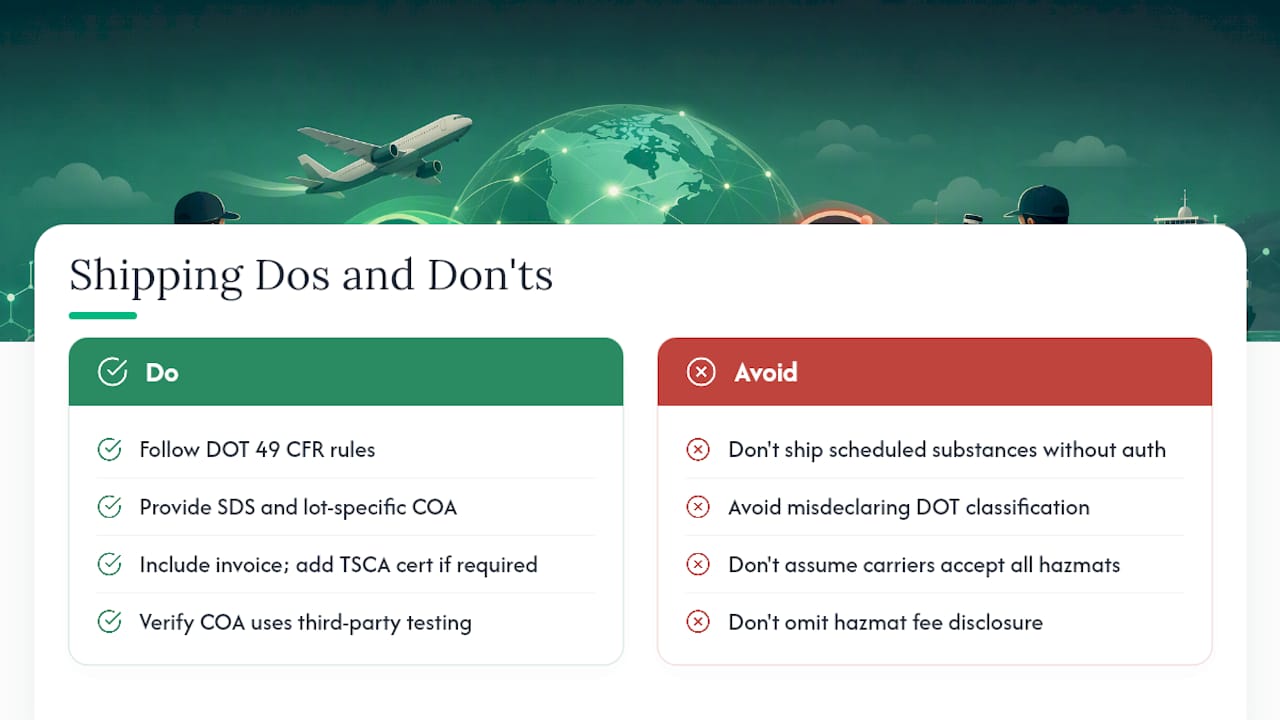
This article is general information, not a substitute for advice from a qualified lawyer. Consult a qualified legal professional about your own circumstances before acting on anything here.
Sources
- TSCA Requirements for Importing Chemicals
- How to use ACE
- eCFR — Part 720 (Premanufacture notice regulations and exemptions)
- Shipping research materials and dangerous goods — Brown University EHS