

Semaglutide Stability: pH, Temperature, and Shelf Life Data
Semaglutide stability is governed primarily by pH and temperature, with buffer species and ionic strength acting as secondary but decisive factors. Preformulation data show degradation accelerates near the peptide’s isoelectric point and drops off at higher pH, which is why researchers targeting parenteral formulations generally aim for a finished-product pH above 7.0. Manufacturer labeling for marketed semaglutide reinforces this pH sensitivity indirectly through storage instructions: refrigerate at 2°C to 8°C before first use, permit defined room-temperature excursions after that, and never freeze.
Quick reference for your bench:
- pH: avoid 4.5–5.5 (near the pI of ~5.4); target pH 7.4 with adequate buffer capacity
- Temperature: short exposure to high heat is tolerable; long-term storage above refrigeration accelerates degradation
- Storage: 2°C to 8°C prior to use; room-temperature windows vary by product and are time-limited
- Analysis: stability-indicating RP-HPLC and LC-HRMS are required to resolve and identify degradants
Stat check: semaglutide’s isoelectric point sits at approximately pH 5.4, and formulations held near that value show measurably worse stability than those buffered at pH 7.4.
Key Takeaways
Semaglutide stability depends most on keeping pH above 7.0 with adequate buffer capacity, since degradation accelerates sharply near its pI of ~5.4 and with prolonged heat exposure.
| Point | Details |
|---|---|
| pH is the dominant variable | Target pH 7.4 with sufficient buffer capacity; avoid the 4.5–5.5 range near the ~5.4 isoelectric point. |
| Heat tolerance is time-limited | Short high-temperature exposure (hours) is tolerable, but sustained elevated temperature drives long-term degradation. |
| Analytical methods must be stability-indicating | Use RP-HPLC/UPLC for routine QC and LC-HRMS to identify unknown degradants by mass. |
| Storage follows label windows | Refrigerate at 2°C to 8°C before first use; observe product-specific room-temperature discard windows and never freeze. |
| Incoming material quality anchors valid data | Neolabpeptides supplies research-grade semaglutide with third-party HPLC/MS verification and lot-specific Certificates of Analysis to establish a reliable starting impurity baseline. |
Table of Contents
- What Drives Semaglutide Stability: pH, Temperature, and Buffer Choice
- Which Analytical Methods Confirm Semaglutide Stability?
- What Degradation Pathways and Impurities Should You Expect?
- How Long Is Semaglutide Stable in Storage?
- How Do Stability Findings Shape Formulation Choices?
- How Should You Design a Semaglutide Stability Study?
- Why Incoming-Material Quality Determines Your Stability Data
- An Editorial Take on Semaglutide Stability Research
- Get Research-Grade Semaglutide With Verified Stability Documentation
- Sources
What Drives Semaglutide Stability: pH, Temperature, and Buffer Choice
Semaglutide’s isoelectric point of roughly pH 5.4 marks the zone where the molecule carries a net neutral charge and loses the electrostatic repulsion that keeps it in solution. Close to that pH, solubility drops and aggregation becomes far more likely. A 2025 preformulation study confirmed the pattern directly: semaglutide held at pH 4.5 to 5.5 degraded faster than the same peptide buffered at pH 7.4, and the study’s authors recommend a finished-product pH above 7.0 for parenteral development work.
Behavior shifts meaningfully across a wider pH panel. At pH 1.2, semaglutide behaves differently than in the mid-range because strong acid conditions suppress ionization patterns tied to aggregation, though this range matters more for oral formulation screening than for injectable development. At pH 4.5–5.5, instability peaks. At pH 7.4, with sufficient buffer capacity, degradation slows considerably. Buffer molarity matters here as much as the pH value itself: a 50 mM phosphate buffer at pH 7.4 gives the ionic strength needed to resist pH drift during storage, which is why it shows up repeatedly as a starting point in preformulation screening.
Temperature adds a second axis. Semaglutide can tolerate short bursts at extreme heat, remaining stable for roughly three hours at 80°C in controlled studies, but sustained exposure at even moderate elevated temperatures drives accelerated long-term degradation. That distinction matters for process design, not just storage.
Practical screening steps:
- Fix a pH panel spanning acidic, near-pI, and physiological range before running any thermal stress.
- Test at least two buffer species (phosphate and acetate) at matched molarity to isolate buffer-specific effects from pH effects.
- Pair each pH/buffer combination with a short high-temperature pulse and a longer moderate-temperature hold to separate acute tolerance from chronic degradation.
Pro Tip: Run your buffer screen at 50 mM and 100 mM phosphate side by side. Molarity differences that look trivial on paper often produce measurable differences in aggregate load after even a week at 25°C.
Which Analytical Methods Confirm Semaglutide Stability?
Three methods carry most of the analytical workload in semaglutide stability programs, each serving a distinct role in the workflow.
- RP-HPLC/UPLC handles routine QC, separating the parent peptide from degradation products with the resolution needed for release and stability testing.
- LC-HRMS identifies unknown degradants by mass, turning a chromatographic peak into a structural hypothesis.
- HPLC-UV methods, optimized for throughput, support high-volume QC screening once a stability-indicating method has been validated.
Method validation for this class of peptide needs to demonstrate clear resolution between the parent compound and its major degradants, not just an acceptable overall peak count. Precision thresholds matter in practice: one application note describing an HPLC-UV method optimized for semaglutide impurity separation reported %RSD values at or below 1.3% across key metrics, a reasonable benchmark when qualifying a method for routine use. Limit of detection and limit of quantitation should be established specifically for the degradants expected under your stress conditions, since generic peptide LOD/LOQ values rarely transfer cleanly to semaglutide’s specific impurity profile.
Sample preparation deserves as much attention as the chromatography itself. Semaglutide’s tendency to aggregate near its isoelectric point means a poorly chosen diluent or an inadvertent pH shift during dilution can generate artefactual degradants that were never present in the original sample. Keep diluent pH matched to the storage buffer, minimize freeze-thaw cycles before injection, and avoid prolonged bench-top holds at room temperature between preparation and injection. RP-HPLC/UPLC paired with LC-HRMS identification remains the accepted combination for fully characterizing what shows up in a forced-degradation chromatogram, since separation alone tells you a peak exists but not what it is.

What Degradation Pathways and Impurities Should You Expect?
Semaglutide degrades through a handful of recurring chemical routes, and forced-degradation work consistently turns up the same categories of impurity regardless of which lab runs the study.
- Hydrolysis cleaves peptide bonds under aqueous stress, particularly at pH extremes.
- Deamidation converts susceptible asparagine or glutamine residues, shifting mass and charge in ways that show up clearly on LC-HRMS.
- Oxidation targets sensitive residues under exposure to air or light.
- Fragmentation produces smaller peptide pieces that co-elute closely with the parent peak if resolution is inadequate.
- Aggregation/oligomerization spikes near the pI, where reduced solubility lets peptide chains associate into higher-order species that standard RP-HPLC may under-detect without a size-based orthogonal method.
A preformulation protocol using LC-HRMS identified around 13 recurring impurities across varied pH, buffer, and temperature conditions, with buffer species shaping which impurities dominate.
| Degradation Route | Typical Trigger | Detection Method |
|---|---|---|
| Hydrolysis | Low pH, aqueous stress | RP-HPLC retention shift |
| Deamidation | Extended storage, near-neutral pH | LC-HRMS mass shift |
| Oxidation | Air/light exposure | LC-HRMS, RP-HPLC |
| Aggregation | Near pI (~5.4) | Size-based assay, RP-HPLC |
Impurity profiling isn’t academic bookkeeping. Regulatory submissions require a defined impurity profile, and unidentified aggregates in particular carry immunogenicity implications that reviewers scrutinize closely.
How Long Is Semaglutide Stable in Storage?
Manufacturer labeling gives the clearest real-world anchor for shelf-life expectations. Refrigerated storage at 2°C to 8°C is standard prior to first use, and DailyMed prescribing information for injectable semaglutide permits room-temperature windows of roughly 28 to 56 days after first use, depending on the specific product and pen device. Freezing is explicitly disallowed across labels, since freeze-thaw cycling promotes aggregation independent of any pH effect.
For research samples, three checks should trigger discard or re-testing before you trust a result:
- Visual inspection for precipitation, cloudiness, or discoloration, checked at every timepoint pull.
- Assay recovery, flagging any sample that drops meaningfully below the initial potency baseline.
- Degradant growth, tracked against a pre-defined acceptance threshold rather than a subjective “looks fine” call.
Stat check: the 28 to 56 day post-first-use window cited in labeling is product-specific, so confirm the exact figure for the presentation you’re referencing rather than assuming a single universal number.
Document any temperature excursion in a stability study with exact duration and peak temperature reached, since accelerated stability data (typically generated at elevated temperatures over defined intervals) is what regulatory shelf-life claims are built on. An undocumented excursion breaks that chain of evidence.
How Do Stability Findings Shape Formulation Choices?
Stability data translates directly into formulation decisions, and the choices differ by route of administration.
- For injectable formulations, buffer choice and pH above 7.0 remain the two biggest levers, with excipient selection (stabilizers that limit surface-driven aggregation) as a secondary tool.
- Lyophilization becomes attractive when liquid-state degradation at your target pH is still too fast for an acceptable shelf life; processing temperature limits during lyophilization need to respect the same thermal ceilings identified in stress testing, since a poorly controlled drying cycle can introduce the exact degradation it’s meant to prevent.
- Oral formulations face a different problem: semaglutide shows reasonable short-term tolerance in acidic conditions, but absorption barriers and oligomerization risk in the gastrointestinal environment complicate the picture beyond what a simple acid-stability test reveals.
- Long-acting injectable (LAI) development leans heavily on the thermal-stress data, since manufacturing processes that involve sustained heat need tight temperature and time control to avoid the long-term degradation profile seen in accelerated studies.
Pro Tip: If you’re screening lyophilization cycles, run a parallel liquid-state control at your target storage temperature. It’s the fastest way to confirm the freeze-drying step isn’t quietly introducing its own degradation pathway.
How Should You Design a Semaglutide Stability Study?
A workable forced-degradation matrix covers temperature, pH, and stress type systematically rather than testing one variable at a time.
- Temperature panel: 5°C, 25°C, 40°C, 60°C, and 80°C, with durations ranging from a few hours at the highest temperature to 28 days at moderate stress conditions.
- pH panel: span from 1.2 through the problematic 4.5–5.5 range up to 7.4, matching the ranges already validated in preformulation literature.
- Additional stresses: oxidative (peroxide spike), photolytic (ICH-standard light exposure), mechanical agitation, and freeze-thaw cycling round out a defensible stress package.
Endpoints to collect at each timepoint:
- Percent assay recovery relative to the initial value
- Percent of each individual degradant, not just total impurity
- Aggregate load via a size-based orthogonal method
- LC-HRMS identification at key timepoints to confirm degradant identity, not just retention time
Map accelerated results to a shelf-life estimate cautiously. Extrapolation only holds when the degradation kinetics stay consistent across the temperature range tested, so include at least one long-term, real-time storage arm alongside the accelerated conditions before finalizing any shelf-life claim.
Why Incoming-Material Quality Determines Your Stability Data
A stability study is only as trustworthy as the starting material behind it. If your baseline sample already carries unknown impurities, every downstream degradant measurement becomes ambiguous. Third-party HPLC and mass spectrometry verification with a lot-specific Certificate of Analysis removes that ambiguity before the first timepoint even gets pulled.
Checks worth confirming on any incoming semaglutide lot:
- HPLC purity above 98%
- MS confirmation of molecular identity
- Absence of residual solvents from synthesis
- Full lot traceability tied to the CoA
A Certificate of Analysis with matched HPLC and mass spectrometry data tells you exactly what impurity profile you started with, which is the only way to attribute a later peak to genuine degradation rather than an unverified starting condition.
…
An Editorial Take on Semaglutide Stability Research
The conventional advice on semaglutide stability treats refrigeration guidance as the whole story. It isn’t. Storage temperature matters, but the research makes clear that pH control is doing most of the actual work, and a lab that nails temperature while ignoring buffer capacity is solving the easier half of the problem.
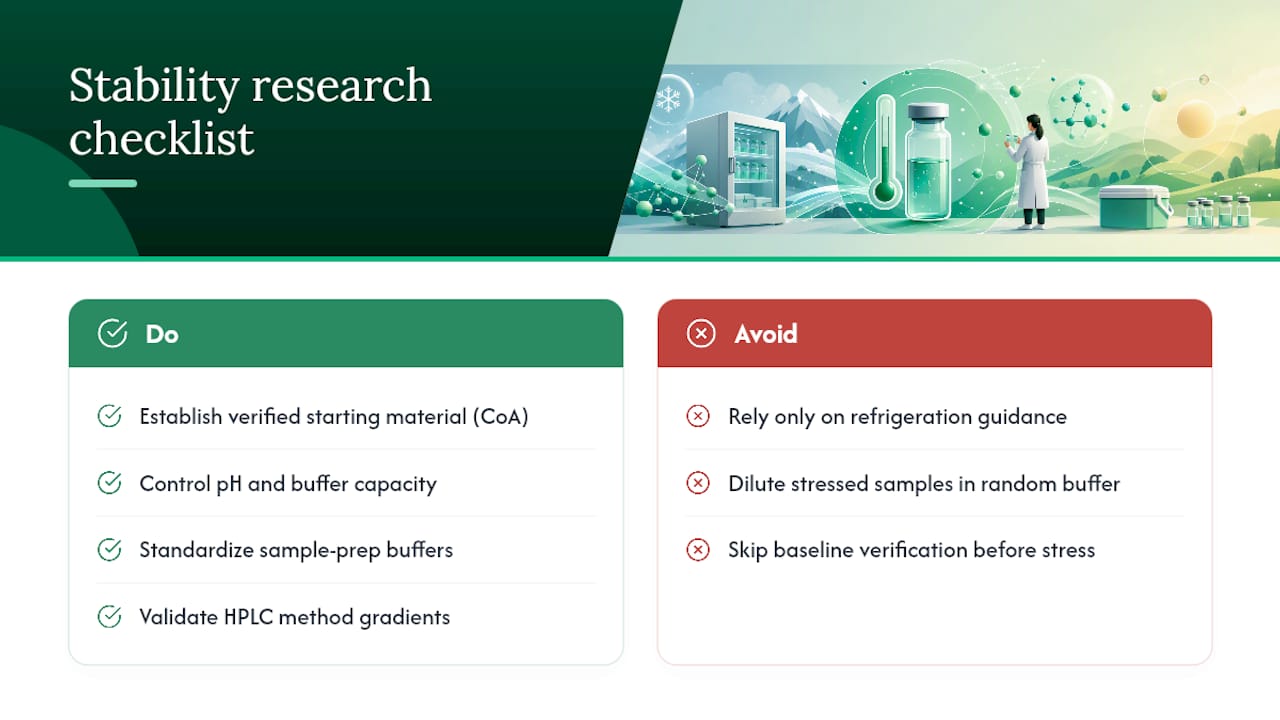
What gets underrated is sample prep. Researchers spend weeks optimizing HPLC gradients and then dilute their stressed samples in whatever buffer happens to be on the bench, unknowingly manufacturing aggregation artifacts that have nothing to do with the actual stress condition being tested. That’s a preventable error, and it’s more common than method-validation failures.
The reader’s first priority should be establishing a clean, verified starting material with a real Certificate of Analysis, not jumping straight to forced-degradation design. Every degradant curve you generate is only meaningful relative to a known baseline. Skip that step, and the most rigorous stress matrix in the world produces data nobody can actually trust.
— Stephan
Get Research-Grade Semaglutide With Verified Stability Documentation
Running the stability protocols in this guide only produces trustworthy data when the starting material is already verified. Neolabpeptides supplies semaglutide and other GLP-1 analogs in lyophilized form with third-party HPLC and mass spectrometry testing above 98% purity, backed by a lot-specific Certificate of Analysis for every order. That means your baseline impurity profile is documented before the first stress timepoint, not guessed at afterward.

Researchers building forced-degradation or preformulation programs can pair that verified starting material with the lyophilization protocols and purity assessment methods outlined across Neolabpeptides’ resource library. Browse the current semaglutide and GLP-1 catalog to check available lots and request a Certificate of Analysis before your next study.
This article is general information, not a substitute for advice from a qualified doctor. Consult a qualified healthcare professional about your own circumstances before acting on anything here.
Sources
- Influence of Buffering Capacity, pH, and Temperature on the Stability of Semaglutide: A Preformulation Study
- Influence of Buffering Capacity, pH, and Temperature on the Stability of Semaglutide: A Preformulation Study (DOI)
- OZEMPIC (semaglutide) injection, for subcutaneous use — DailyMed