

Research Use Only: A Regulatory Guide for Lab Professionals
“Research Use Only” (RUO) is a formal U.S. regulatory labeling designation, grounded in 21 CFR 809.10©(2)(i), that restricts a product to laboratory research phases and excludes it from clinical diagnostic use. The label is not a legal shield. Under the FDA’s Objective Intent Doctrine, the agency evaluates the entire marketing and distribution context, not just the disclaimer printed on the vial, to determine whether a product is genuinely RUO or is being sold as an unapproved drug or misbranded device.
The core risk: a supplier who prints “For Research Use Only” on a label while simultaneously publishing dosing instructions, therapeutic claims, or bundled administration supplies has not protected themselves or their buyers from FDA enforcement action.
Table of Contents
- What does “Research Use Only” actually mean in practice?
- What are the FDA’s three conditions for RUO status?
- What enforcement risks come with misusing an RUO label?
- What are your responsibilities when using RUO products in the lab?
- How do you vet an RUO supplier before purchasing?
- Key Takeaways
- The gap between the RUO label and actual compliance
- Neolabpeptides: verified RUO peptides for institutional research
- Useful sources and further reading
What does “Research Use Only” actually mean in practice?
RUO is the label category the FDA created for reagents, test systems, and instruments that are still in the laboratory research phase of development. Think bench antibodies, ELISA components, PCR primers, and assay reagents being evaluated before any clinical or diagnostic application is established. The designation tells regulators, procurement officers, and laboratory staff that the product has not been reviewed for diagnostic accuracy, has not cleared premarket review, and carries no representation of clinical effectiveness.
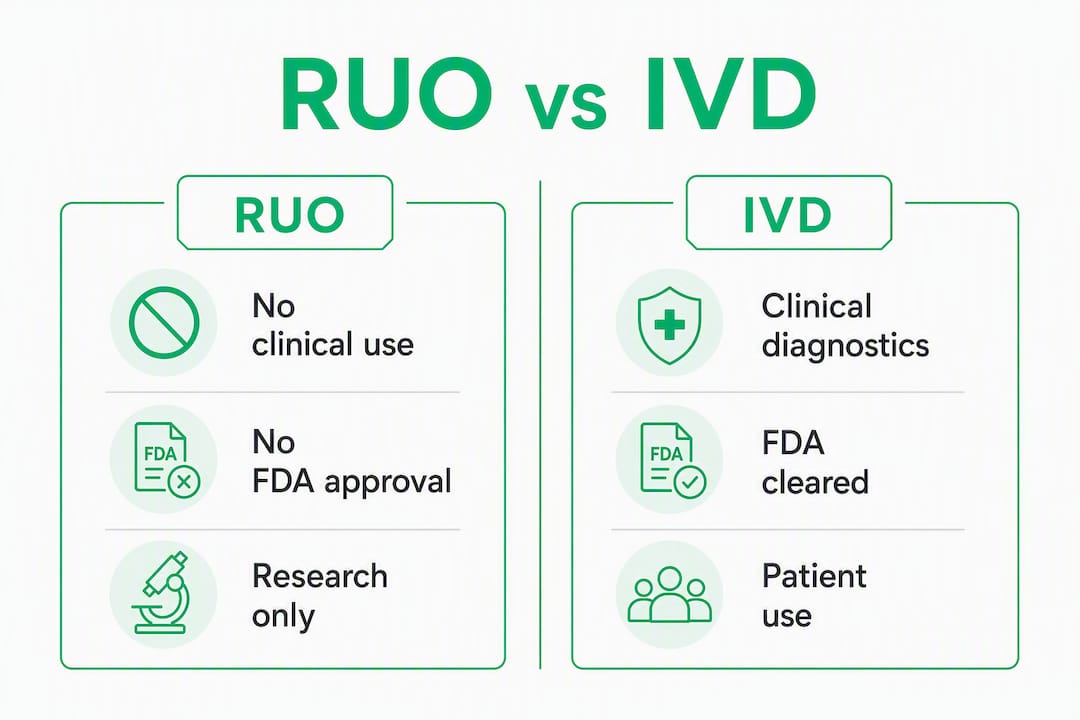
The practical meaning for researchers: you can use RUO materials for assay development, biomarker discovery, and exploratory bench work. You cannot use them to generate results that inform patient diagnosis or treatment decisions without first completing a validation pathway that meets your institution’s and the FDA’s requirements for that application.

The label phrase “Not for Human Consumption” often appears alongside or instead of RUO language on research-grade materials. That designation signals that the material has not undergone human clinical testing, GMP manufacturing controls, or regulatory approval for human administration. It marks a regulatory boundary, not a safety certification.
How RUO compares to IVD, IUO, and clinical-use products
| Category | Intended Use | Premarket Review | QMS (21 CFR Part 820) | Label Requirement |
|---|---|---|---|---|
| RUO | Laboratory research only | Not required | Exempt | “For Research Use Only. Not for use in diagnostic procedures.” |
| IUO | Active clinical investigation | Not required (with conditions) | Partial | “For Investigational Use Only.” |
| Cleared/Approved IVD | Clinical diagnosis | 510(k) or PMA required | Full compliance | Cleared intended use statement |
| Clinical-Use Reagent | Validated diagnostic workflow | Required | Full compliance | Specific indication per clearance |
Key distinctions worth noting:
- RUO products are exempt from most IVD device obligations, including premarket notification and post-market surveillance reporting.
- IUO products are in active clinical investigation; they carry more oversight than RUO but less than a cleared device.
- Once a lab begins using an RUO reagent to generate clinically actionable results, the product’s effective intended use has changed, regardless of what the label says.
- The RUO framework was designed for bench reagents, not for systemically active molecules. Applying an RUO label to an injectable or orally bioavailable compound does not convert it into a research reagent under FDA’s analysis.
What are the FDA’s three conditions for RUO status?
21 CFR 809.10©(2)(i) sets out three simultaneous conditions a product must meet to qualify for RUO exemption from IVD labeling requirements:
- The product is in the laboratory research phase of development. It has not yet been validated for clinical diagnostic use and is not being represented as ready for that purpose.
- The product is not represented as an effective in vitro diagnostic. No claims of diagnostic accuracy, clinical sensitivity, or patient-outcome relevance appear in labeling or promotion.
- The labeling bears a prominent RUO statement. The statement must appear clearly on the product label, not buried in fine print.
The exact phrase the FDA references in guidance and exemptions under 21 CFR 809.10 is:
All three conditions must be satisfied simultaneously. A product that carries the statement but is marketed with clinical performance claims fails condition two. A product in genuine research phase but lacking the label statement fails condition three.

When RUO status applies, the following obligations are lifted: premarket 510(k) or PMA review, full 21 CFR Part 820 quality management system compliance, and post-market surveillance reporting. What remains are basic labeling minimums: the RUO statement itself, net quantity, manufacturer identity, and a lot number that ties back to manufacturing history. Those minimum traceability elements are non-optional even for exempt products.
What enforcement risks come with misusing an RUO label?
The FDA’s enforcement authority over misused RUO labels flows from the Federal Food, Drug, and Cosmetic Act (FD&C Act). A product sold with an RUO label but marketed for clinical or therapeutic use can be cited as a misbranded device, an unapproved drug, or both.
The Objective Intent Doctrine is the mechanism. Under this doctrine, intended use is determined by the totality of labeling, advertising, written and oral statements, and the circumstances of distribution. A vendor’s website, email communications, social media posts, and the ancillary items shipped with the product all count as evidence of intended use. The RUO disclaimer on the label is one data point among many, and it does not override contrary evidence.
FDA warning letters in 2024–2025 cited promotional language, dosing directions, and bundled administration items as evidence that RUO labels were being misused. Therapeutic claims and consumer-facing marketing were the most common triggers.
Possible consequences for manufacturers and distributors who misuse RUO labeling:
- FDA warning letters requiring corrective action and written response within 15 business days
- Product seizure under FD&C Act authority
- Misbranding allegations, which carry civil and criminal penalties
- Unapproved new drug allegations when the compound is pharmacologically active
- Injunctions against continued distribution
The SAFE Drugs Act (2025) narrowed a legal argument some vendors had used to sell drug-identical molecules under RUO labels. Vendors selling compounds identical to FDA-approved drugs now face higher legal exposure, regardless of the disclaimer on the label.
Pro Tip: Audit any vendor’s full digital presence before purchasing. If their website, social media, or customer communications include dosing schedules, before-and-after testimonials, clinical outcome claims, or bundled syringes and diluents, treat that as a red flag for enforcement risk. Document your due diligence in writing.
What are your responsibilities when using RUO products in the lab?
RUO status intentionally transfers the reliability burden to the researcher. Because RUO products bypass many diagnostic controls, your laboratory must validate fit-for-purpose performance independently. That validation is not optional when results will inform any downstream decision, even an internal one.
A practical validation checklist for RUO reagents and compounds:
- Sensitivity and specificity testing. Confirm the material performs as expected in your specific assay format and matrix before committing to a larger study.
- Stability assessment. Verify storage conditions, freeze-thaw tolerance, and shelf-life under your lab’s actual conditions, not just the supplier’s stated conditions.
- Matrix effects evaluation. Test the material in the biological matrix you intend to use. RUO reagents validated in buffer may behave differently in serum, plasma, or tissue homogenate.
- Lot-to-lot consistency checks. When you receive a new lot, run a side-by-side comparison with your validated lot before switching over.
- Documentation of performance. Record all validation data in a retrievable format. Include instrument settings, analyst ID, date, lot number, and raw results.
RUO fits into a development pathway: research phase (RUO) leads to investigational use (IUO), which leads to a validated IVD or clinical product with full regulatory clearance. Moving results from the RUO phase into clinical decision-making without completing that pathway is where institutional and regulatory risk accumulates.
Institutional compliance steps that often accompany RUO use:
- Biosafety review when working with human-derived specimens or biohazardous materials
- IRB or ethics committee approval when human specimens are involved in research protocols
- Procurement policy documentation confirming the product was purchased for research purposes
- Recordkeeping that links each experiment to the specific lot and CoA of the material used
How do you vet an RUO supplier before purchasing?
Supplier quality is not self-certifying. The RUO label tells you what the product is not; your procurement process determines whether it is actually what you need. A structured vetting approach reduces the risk of receiving mislabeled, degraded, or impure materials.
Supplier checklist:
- Certificate of Analysis (CoA) with method details. The CoA should specify the analytical method (HPLC, mass spectrometry), the purity result as a percentage, retention time, and lot number. A CoA that lists only a purity number without the underlying method data is insufficient.
- Third-party testing. Prefer suppliers who use independent laboratories for purity and identity confirmation rather than relying solely on in-house testing. Peptide third-party testing via HPLC and mass spectrometry is the industry standard for research-grade materials.
- Lot traceability. The lot number on your CoA should tie back to manufacturing records. Ask whether the supplier can provide batch-specific documentation on request.
- Stability and storage data. Confirm the supplier provides stability data for the specific formulation and storage conditions, particularly for lyophilized peptides.
- Institutional sales practices. Ask whether the supplier sells exclusively to research institutions and qualified professionals, or whether the same products are available to general consumers without qualification.
Pro Tip: Before placing an order, review the supplier’s CoA format and confirm it includes the analyst ID, test date, instrument method, and chromatogram or spectral data. A CoA missing any of those elements cannot be used to defend your lab’s use of the material in an audit.
When evaluating a CoA, verify these specific elements:
- Purity percentage with the method used to derive it (HPLC area percent or similar)
- Molecular weight confirmation from mass spectrometry
- Retention time from the HPLC run
- Lot number matching the product label
- Date of analysis and analyst or laboratory identification
Understanding purity criteria before procurement helps you set minimum acceptable thresholds for your specific application. For most research-grade peptides, 98%+ purity by HPLC is the standard benchmark.
Key Takeaways
RUO is a regulatory label with defined legal conditions, not a blanket exemption from FDA oversight, and laboratories bear the validation burden for every RUO material they use.
| Point | Details |
|---|---|
| RUO has a statutory basis | 21 CFR 809.10©(2)(i) sets three simultaneous conditions; all must be met for RUO exemption to apply. |
| The label is not a legal shield | FDA’s Objective Intent Doctrine evaluates the full marketing context, not just the disclaimer on the label. |
| Labs carry the validation burden | RUO products bypass diagnostic controls, so your lab must independently verify sensitivity, specificity, stability, and matrix performance. |
| CoA quality signals supplier integrity | Demand HPLC and mass spectrometry results, lot traceability, analyst ID, and test date on every CoA before purchasing. |
| Neolabpeptides supplies verified RUO peptides | All products ship with third-party HPLC/MS-verified CoAs and 98%+ purity, sold exclusively for laboratory research use. |
The gap between the RUO label and actual compliance
The most common mistake laboratories make with RUO materials is treating the supplier’s label as a compliance endpoint. It is not. The label tells you the product has not been reviewed for diagnostic use. It says nothing about whether the supplier is operating within the bounds of that designation, whether the purity data is independently verified, or whether your lab’s use of the material is defensible under your institution’s protocols.
The RUO framework was built for bench reagents, and it works well there. The friction appears when the same label is applied to pharmacologically active compounds, injectable peptides, or molecules structurally identical to approved drugs. In those cases, the regulatory analysis becomes more complex, and the Objective Intent Doctrine gives the FDA wide latitude to look past the label and examine how the product is actually being sold and used.
For laboratory professionals, the practical takeaway is straightforward: your due diligence does not end at the purchase order. It includes vetting the supplier’s full marketing posture, demanding independently verified CoAs, documenting your validation work, and escalating to your institution’s compliance team when a vendor’s behavior raises questions. A supplier who refuses to provide batch-specific documentation, who markets to consumers alongside institutional buyers, or who bundles administration supplies with research compounds is signaling a compliance posture that creates risk for your lab, not just for themselves.
Neolabpeptides: verified RUO peptides for institutional research

Neolabpeptides supplies research-grade peptides, including IPAMORELIN, CJC-1295, TB-500, BPC-157, GLP-1 analogs, NAD+, and GHK-CU, exclusively for laboratory and scientific research use. Every product ships with a third-party-verified Certificate of Analysis confirming 98%+ purity by HPLC and mass spectrometry, along with full lot traceability. No product is sold with dosing instructions, administration guidance, or consumer-facing claims. Sales are directed to qualified researchers, laboratory professionals, and institutional procurement teams.
For procurement officers and lab managers who need to document supplier compliance as part of their RUO material vetting process, Neolabpeptides provides batch-specific CoA documentation on every order. Products are supplied in lyophilized form with clearly labeled RUO statements and manufacturer identification meeting minimum labeling requirements.
Browse the full catalog or review a specific product example, such as BPC-157 10mg, to confirm CoA format and testing documentation before placing an institutional order.
Useful sources and further reading
The following primary and authoritative sources support the regulatory analysis in this article and are recommended for compliance reviews, procurement policy updates, and institutional training materials.
Primary regulatory sources:
- FDA Guidance: Distribution of In Vitro Diagnostic Products Labeled for Research Use Only or Investigational Use Only — the FDA’s definitive guidance document on RUO/IUO distribution, Objective Intent Doctrine, and enforcement expectations
- Federal Register Notice — FDA Docket No. FDA–2011–D–0305 (GovInfo PDF) — the Federal Register notice announcing availability of the RUO/IUO guidance for industry and FDA staff
- FDA Overview of IVD Regulation — background on the broader IVD regulatory framework within which RUO sits
Regulatory analysis and industry commentary:
- Jama Software: Research Use Only (RUO) — Definition and FDA Rules — practical explanation of RUO label requirements, minimum labeling elements, and QMS exemptions
Laboratory procurement and CoA guidance:
- How to Read a Peptide Certificate of Analysis — Neolabpeptides — step-by-step guide to evaluating CoA elements for research-grade peptides
This article is general regulatory information, not legal or compliance advice. Confirm current rules and their application to your specific products and workflows with a qualified regulatory professional or your institution’s compliance team.