

Sequence Risks, CamSol, and a 6 Step Protocol for Peptide Solubility
Peptide solubility comes down to three sequence traits, net charge, hydrophobicity, and length, interacting with pH and solvent choice. When a peptide won’t go into solution, the fix usually starts with the mildest compatible solvent: sterile water or a dilute acid or base matched to the peptide’s charge profile, tested on a small aliquot before committing the full vial.
TL;DR:
- Peptide solubility primarily depends on sequence traits like net charge, hydrophobicity, and length, which influence their interaction with pH and solvents.
- Avoid dissolving peptides near their isoelectric point and use mild solvents such as water, dilute acids, or bases based on the peptide’s charge profile, testing on small aliquots first.
- A stepwise protocol involving gentle sonication, slow dilution, and escalation to organic co-solvents prevents wasted material and ensures accurate solubility assessment.
- Computational tools like CamSol-PTM can predict intrinsic solubility from sequence, helping to identify risky designs before synthesis.
- Proper storage of lyophilized peptides in cold, dry conditions and rigorous validation of purity are essential to prevent insolubility caused by impurities or degradation.
Table of Contents
- Why Are Peptides Insoluble? Sequence Determinants That Matter
- A Stepwise Dissolution Protocol You Can Reproduce Every Time
- Choosing Solvents and Co-Solvents Without Wrecking Your Assay
- Troubleshooting Aggregation, Gel Formation, and False Solutions
- Using Sequence-Based Solubility Predictors Like CamSol-PTM
- Storing Lyophilized Peptides and Reconstituted Stocks Correctly
- What Ten Years of Failed Dissolutions Taught Me
- Why Verified Purity Matters Once Solubility Is Solved
- Sources
Why Are Peptides Insoluble? Sequence Determinants That Matter
Most solubility problems trace back to the sequence itself, not bad luck at the bench. Net charge, hydrophobic content, and chain length interact to determine whether a peptide will disperse in aqueous buffer or clump into an insoluble mess.
Start with net charge. Calculate the isoelectric point (pI) from the ratio of acidic residues (Asp, Glu) to basic ones (Lys, Arg, His), and avoid dissolving anywhere near that pI, since the peptide carries little net charge there and aggregates readily. A peptide with a pI around 6.5 dissolved in neutral PBS is fighting its own chemistry.
Hydrophobicity is the second lever. Sequences rich in Leu, Ile, Val, Phe, and Trp behave like small hydrophobic proteins: they resist water and prefer organic solvents. Bachem’s solubility guidance groups peptides by acidic, basic, polar, and nonpolar character precisely because that classification predicts which solvent family will work.
Length compounds both effects. Longer chains have more surface area for hydrophobic patches to cluster, and more charged residues to push and pull against each other.
- Cysteine and methionine oxidize easily, changing solubility mid-experiment.
- Tryptophan and other bulky aromatics increase aggregation risk in aqueous buffer.
- Noncanonical or non-natural residues often behave unpredictably without sequence-based modeling.
Statistic Callout: Sequence-based prediction of intrinsic solubility for peptides containing non-natural amino acids achieved Pearson correlations of roughly 0.6 to 0.8 against experimental measurements, a strong enough signal to flag risky designs before synthesis.
A Stepwise Dissolution Protocol You Can Reproduce Every Time
Guesswork wastes peptide. A documented, escalating protocol lets you recover from a failed attempt instead of burning through your only vial.
- Dissolve a small aliquot first. Weigh out a fraction of the total peptide, not the whole vial, and record the exact solvent and volume used.
- Start mild. Try sterile water or 0.1% acetic acid for basic peptides, or dilute ammonium bicarbonate for acidic ones, following the stepwise strategy Sigma-Aldrich outlines.
- Sonicate briefly and gently. Short pulses at low power, not sustained heat, since prolonged sonication risks degrading the peptide backbone.
- Dilute dropwise. Add buffer slowly while swirling, watching for haze or precipitate at each addition.
- Escalate only if needed. Move to organic co-solvents or chaotropes if water and dilute acid/base fail.
- Lyophilize and retry if a solvent proves incompatible, rather than pushing forward with a compromised stock.
A reconstitution calculator helps you nail down concentration targets before you start, which avoids the common error of diluting past the point where you can accurately measure activity.
Pro Tip: Log every solvent attempt on the vial label itself, not just in your notebook. A vial that has already seen DMSO behaves differently than a fresh one, and you’ll thank yourself in three months.
Stop escalating and get analytical confirmation once you’ve tried two solvent tiers without success. Continuing to force a dissolution rarely ends well.
Choosing Solvents and Co-Solvents Without Wrecking Your Assay
Solvent choice should match the peptide’s chemistry, not just what’s on the shelf. Merck Millipore’s handling protocol is blunt about this: there is no universal solvent, and stronger solvents should be reserved for peptides that genuinely need them.
- Basic peptides: water first, then dilute acetic acid (0.1% to 10%) if charge repulsion resists dissolution.
- Acidic peptides: water first, then dilute ammonium bicarbonate or ammonium hydroxide.
- Neutral, hydrophilic peptides: water or PBS usually works without escalation.
- Hydrophobic peptides: DMSO, DMF, or acetonitrile, dissolving in a minimal volume before diluting into buffer, as ChemVerify’s practical guide recommends.
Where possible, favor volatile solvents like dilute acetic acid, since you can remove them by lyophilization if the solvent turns out to interfere with downstream detection.
Troubleshooting Aggregation, Gel Formation, and False Solutions
A clear-looking vial doesn’t guarantee a true solution. Hazy or opalescent samples are often suspensions, not dissolved peptide, and gel formation usually signals self-assembly rather than a solvent problem you can dilute away.
- Visual check: hold the vial to light. True solutions are optically clear; suspensions scatter light visibly.
- Bench check: spin down briefly. A pellet after centrifugation means undissolved material, not full solubility.
- Sonication limits: brief, low-power pulses can help; extended or high-intensity sonication risks heat-driven degradation, particularly for peptides with oxidation-prone residues.
- Warming guidance: mild warming (below 40°C) can assist some sequences, but heat accelerates degradation in Cys- or Met-containing peptides.
Aggregation is a leading cause of apparent solubility failure, and analytical methods settle the question definitively. Size exclusion chromatography (SEC) and dynamic light scattering (DLS) detect aggregates that look invisible to the eye, while HPLC and mass spectrometry confirm whether the compound present is actually your intended peptide at the expected mass and purity.
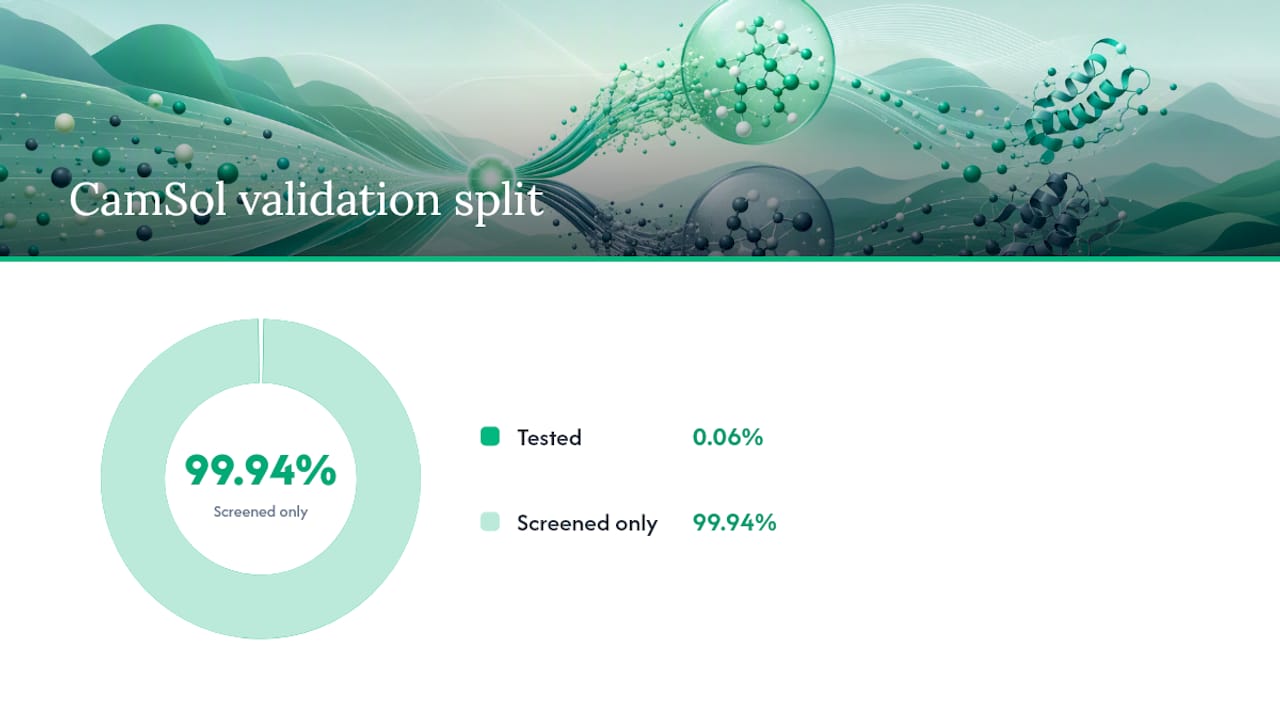
Statistic Callout: CamSol-PTM’s validation involved screening 50,000 sequence variants and experimentally testing 30 peptides, giving researchers a benchmark for how far in-silico predictions can be trusted before bench work.
Using Sequence-Based Solubility Predictors Like CamSol-PTM
Computational screening earns its place early, before you commit synthesis budget to a risky design. CamSol-PTM predicts intrinsic solubility directly from sequence, including for peptides containing non-natural amino acids, and its correlation with measured solubility gives it real predictive weight.
- Run candidate sequences through CamSol-PTM before ordering synthesis, especially for designs with heavy modification.
- Treat the output as intrinsic solubility only. It does not account for your specific buffer, ionic strength, or pH.
- Use predictions to rank variants, then validate only the top candidates experimentally rather than testing everything blind.
The tool’s own validation data acknowledges this boundary: sequence-based scores describe the peptide’s inherent tendency, while solvent and solution conditions still swing real-world results.
Pro Tip: Run the same peptide through CamSol-PTM before and after a planned modification, like adding a PEG tag or swapping a residue. The delta tells you whether the change helps or hurts before you spend a single milligram confirming it at the bench.
Storing Lyophilized Peptides and Reconstituted Stocks Correctly
Lyophilized powder holds up well at minus 20°C or colder, protected from light and moisture, often stable for a year or more unsealed properly. Reconstituted solutions are far less forgiving.
- Store lyophilized powder at minus 20°C or minus 80°C in a desiccated, sealed container.
- Avoid keeping reconstituted peptide in solution for extended periods; aliquot and freeze instead of repeated freeze-thaw cycles.
- For Cys- or Met-rich sequences, degas buffers and consider a mild reducing agent to limit oxidation during storage.
- Check the Certificate of Analysis for lot-specific solubility notes before you reconstitute a new batch.
What Ten Years of Failed Dissolutions Taught Me
Most wasted peptide comes from skipping the cheap steps: screening a sequence in silico, testing a tiny aliquot, and confirming purity before blaming the solvent. Researchers reach for harsher solvents too fast, when the real problem is often oxidation or a pI mismatch that a five-minute calculation would have caught. Track every vial’s solvent history. It saves more material than any single technique on this list.
— Stephan
Why Verified Purity Matters Once Solubility Is Solved
Once you’ve worked out the right solvent and protocol, the variable you can’t troubleshoot around is peptide quality itself.

If a peptide resists dissolution even after you’ve followed the escalation steps above, impurities or degradation products are a common hidden cause, not just sequence chemistry. That’s the point to consider third-party testing or switching to a supplier whose COAs document exact purity and identity for every lot. Neolabpeptides also publishes practical reconstitution and lyophilization guides alongside its catalog of IPAMORELIN, CJC-1295, TB500, BPC-157, and GLP-1 analogs. Browse the current catalog to compare COA data before your next order, all products supplied strictly for laboratory research use.
Sources
- Sequence-based prediction of the intrinsic solubility of peptides containing non-natural amino acids | Nature Communications
- Peptide solubility - Bachem
- Solubility Guidelines for Peptides | Sigma-Aldrich
- Synthetic Peptide Handling & Storage Protocol | Merck Millipore
- Peptide Solubility Guide: Choosing the Right Solvent for… | ChemVerify