

Peptide Purity for Researchers: A Complete Lab Guide
Peptide purity is the fraction of a sample that consists of the intended peptide sequence, and knowing which measurement method produced that number is as important as the number itself. Two distinct values matter here: chromatographic purity, expressed as RP-HPLC area percent, and absolute peptide content, expressed as mass of peptide per total sample mass. A lot reported at high purity by HPLC area percent may contain substantially less peptide by mass once TFA counterions and residual moisture are accounted for. Before you use any lot, check three things on the COA: the RP-HPLC method details (column, gradient, detection wavelength), the MS identity confirmation (observed vs. theoretical mass), and whether peptide content or a mass-balance figure is reported. For quantitative assays, dosing studies, or potency work, require a content-verified lot or run an independent assay. For qualitative screening, a well-documented HPLC+MS COA at ≥85% is often sufficient. Neolabpeptides supplies COAs with HPLC and MS data for every lot, with purity verified at over 98% HPLC area percent through third-party testing. Note that a 98% HPLC area percent may correspond to substantially lower net peptide content if counterions or moisture are present.
- Check the purity type: HPLC area percent ≠ absolute peptide content. Ask for net peptide content (NPC) when dosing accuracy matters.
- Verify the method: Column chemistry, gradient, run time, and detection wavelength must all appear on the COA.
- Confirm identity: MS or LC-MS/MS data showing observed vs. theoretical mass is non-negotiable.
- Know your threshold: ≥85% for functional screens, ≥95% for quantitative work, mass-balance for preclinical or regulatory studies.
- Request the USP mass-balance approach for reference standards, GMP materials, or any work where inter-laboratory reproducibility is required.
Pro Tip: When you receive a new lot, record the COA purity type (area % vs. NPC) in your lab notebook alongside the lot number. This single habit prevents dosing errors when switching between lots from different vendors.
Table of Contents
- What analytical methods actually measure peptide purity?
- How to read and critically interpret a Certificate of Analysis
- What purity threshold does your application actually require?
- What impurities appear in synthetic peptides and why do they matter?
- How should you order, store, and handle peptides to preserve quality?
- Where can you get peptides independently tested?
- How Neolabpeptides validates and documents peptide purity
- When does mass-balance purity assignment become necessary?
- Key Takeaways
- The procurement mistake most labs keep making
- Neolabpeptides: verified purity with full documentation on every lot
- Primary references and standards to consult next
What analytical methods actually measure peptide purity?
Choosing the right test panel starts with understanding what each method reports and where it can mislead you.
Reversed-phase HPLC
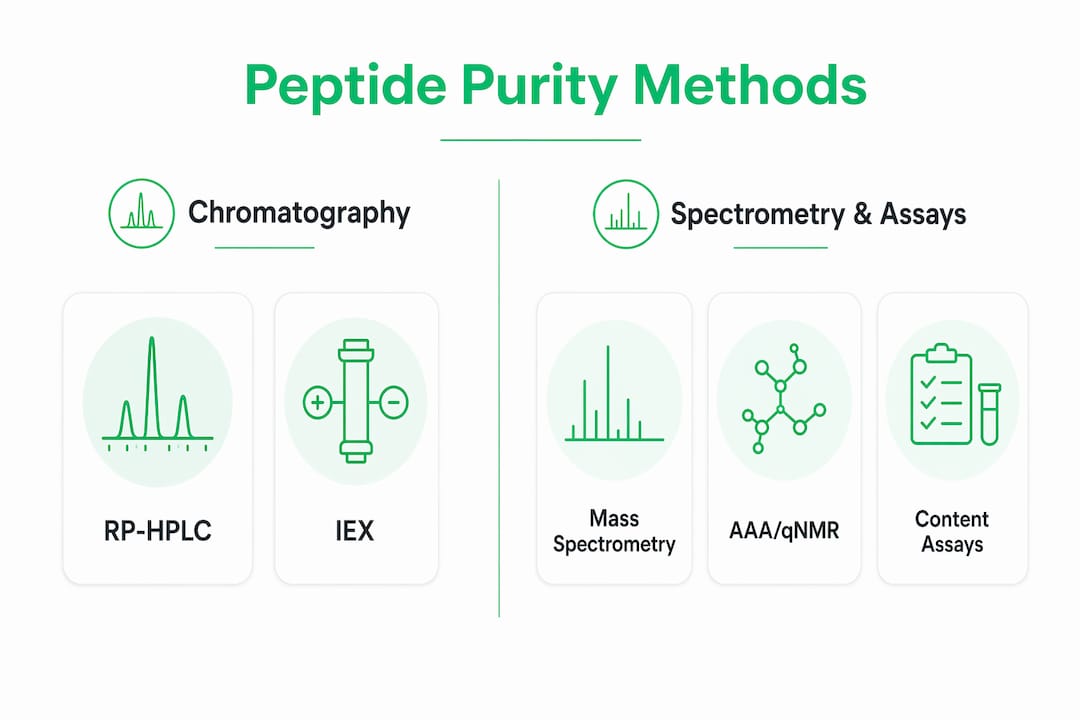
RP-HPLC is the primary analytical mode for peptide purity assessment because it separates peptides by hydrophobicity, is compatible with UV detection at 214–220 nm (the peptide bond absorbance), and couples directly to mass spectrometry. Most labs run RP-HPLC below pH 3.0 using TFA/acetonitrile mobile phases to suppress ionic interactions with silica packings and sharpen peak shapes. The output is an area percent: the target peptide peak divided by the sum of all detected peaks. That number is only as reliable as the integration parameters and the detector’s ability to see every impurity present.
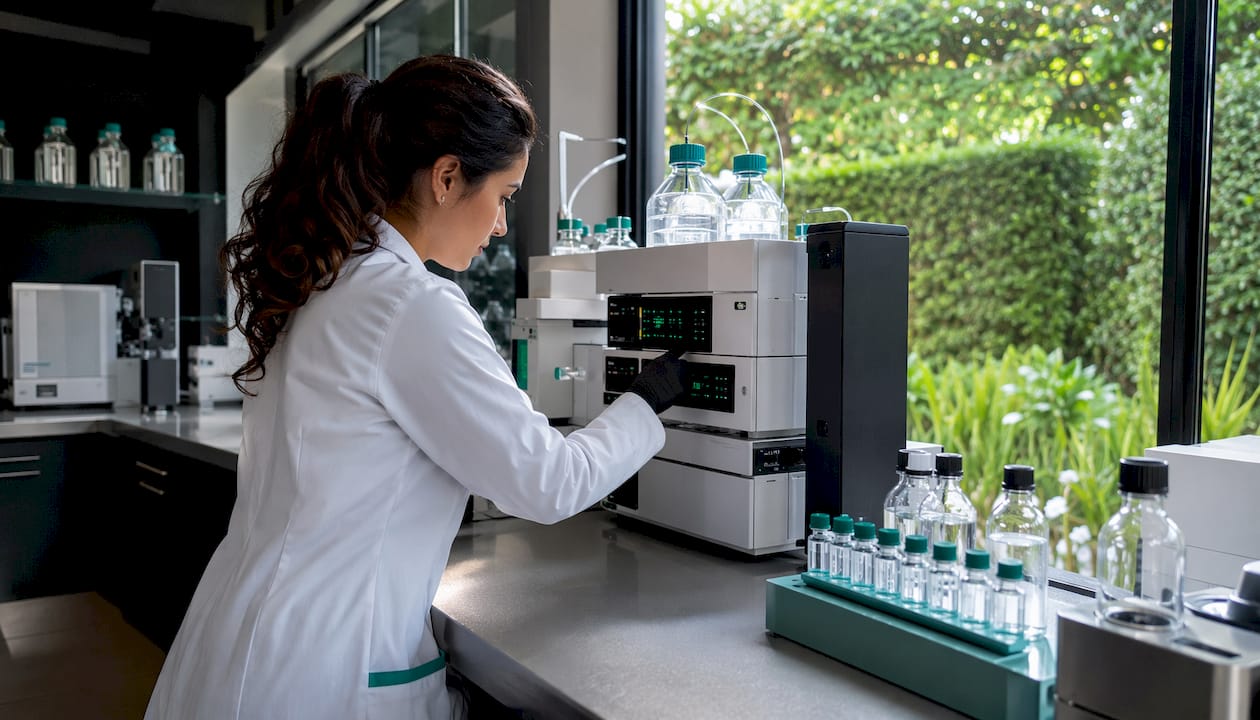
Critical limitations: co-eluting impurities inflate the apparent purity, UV-silent species (counterions, inorganic salts) are invisible, and late-eluting hydrophobic species may be missed if the gradient is too short. Integration parameter choices, particularly baseline placement and peak detection thresholds, can shift the reported value by several percentage points.
Orthogonal chromatographic modes
Ion-exchange chromatography (IEX) separates by charge rather than hydrophobicity, making it useful for detecting charge-variant impurities that co-elute with the target in RP-HPLC. Size-exclusion chromatography (SEC) resolves aggregates and high-molecular-weight species. Mixed-mode columns combine hydrophobic and ionic retention, which can resolve impurities that neither RP nor IEX alone separates. These modes are not routine for every lot but become important when the target peptide has multiple basic residues, a tendency to aggregate, or when a regulatory submission requires orthogonal evidence.
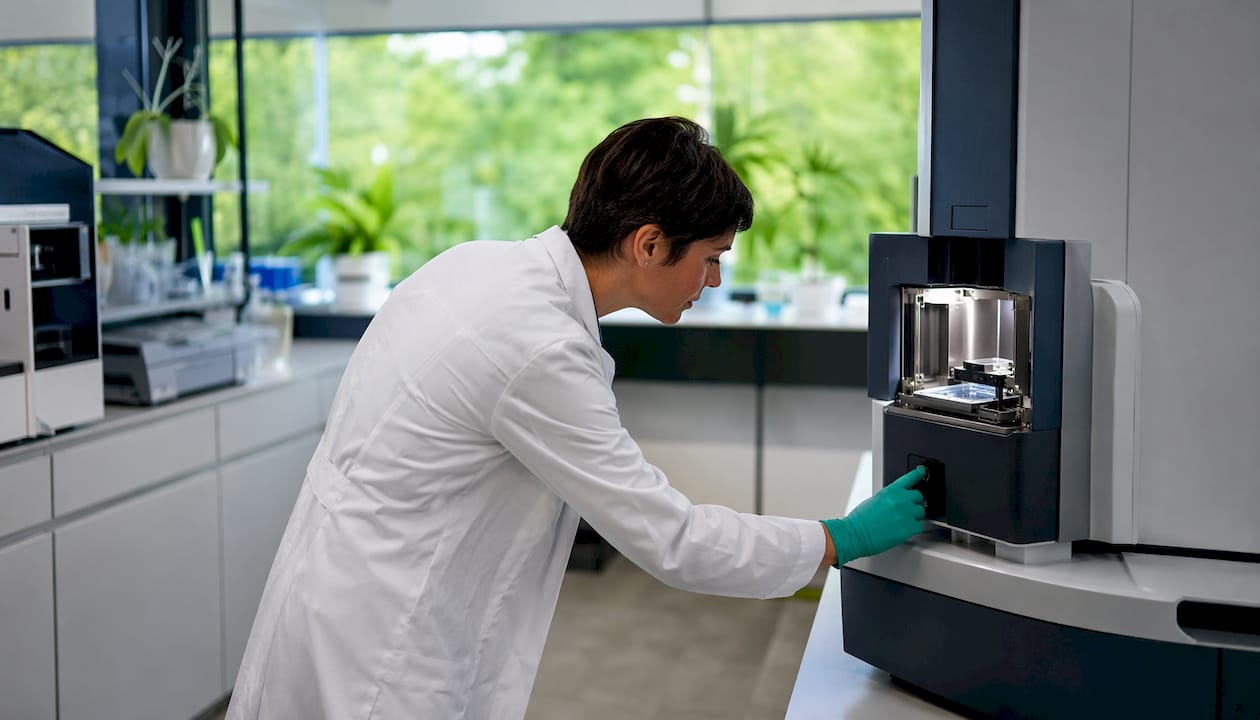
Mass spectrometry
ESI-MS, MALDI-TOF, and LC-MS/MS confirm molecular identity by comparing observed mass to the theoretical monoisotopic or average mass. MS does not quantify impurities directly unless you run selected-reaction monitoring (SRM) or data-independent acquisition with reference standards. Its key limitation: isobaric impurities (same nominal mass, different sequence) and sequence isomers are invisible to a simple MS scan. LC-MS/MS with fragmentation can resolve some of these, but it requires method development specific to the peptide.
Content and counterion assays
Amino acid analysis (AAA), quantitative NMR (qNMR), and residue on ignition (ROI) feed into net peptide content (NPC) calculations. AAA hydrolyzes the peptide and quantifies each amino acid against calibrated standards, giving an absolute mass fraction. qNMR uses an internal standard to assign absolute content without a peptide-specific calibrator. Moisture content by Karl Fischer titration and ROI for inorganic residues complete the mass-balance picture. Together, these assays let you calculate: NPC = 100% minus (chromatographic impurities + counterions + moisture + inorganic residues).
| Method | Primary output | Detects UV-silent impurities | Quantitative content | Typical use case |
|---|---|---|---|---|
| RP-HPLC | Area percent purity | No | No | Routine lot release |
| IEX / SEC | Charge/size variants | No | No | Orthogonal confirmation |
| ESI-MS / MALDI-TOF | Molecular identity | No | No | Identity confirmation |
| LC-MS/MS (SRM) | Targeted impurity levels | Partial | Partial | Regulatory impurity profiling |
| AAA | Amino acid content | Yes | Yes | NPC, dosing accuracy |
| qNMR | Absolute content | Yes | Yes | Reference standard assignment |
| 19F-NMR / ELSD | Residual TFA | Yes | Yes | Counterion quantitation |
Pro Tip: Run RP-HPLC and MS as a minimum pair. If your assay involves dosing or potency, add AAA or qNMR on at least the first lot from any new vendor to establish a baseline NPC correction factor.
How to read and critically interpret a Certificate of Analysis
A COA is only as useful as the method details it contains. The utility of a COA depends more on method transparency than on the purity percentage itself, because the method determines which impurities the reported number actually covers.
Essential COA fields
- Purity type: Is the reported value HPLC area percent or net peptide content? These are not interchangeable. If the COA says “purity: 98%” without specifying the method, treat it as area percent until confirmed otherwise.
- HPLC method details: Column chemistry (C18, C8, phenyl), column dimensions, mobile phase composition, gradient profile, run time, flow rate, and detection wavelength must all be present. A 214 nm detection captures more impurities than 254 nm; knowing the wavelength tells you how sensitive the method was.
- Injection mass: Overloading a column suppresses resolution and artificially inflates apparent purity.
- Raw chromatogram or screenshot: A numeric purity value without a chromatogram is unverifiable. Request the raw trace if it is not included.
Identity confirmation fields
- MS type: ESI, MALDI, or LC-MS/MS.
- Observed vs. theoretical mass: Both values must appear, along with mass accuracy (ideally within 0.1 Da or 5 ppm for high-resolution instruments).
- Charge states observed: Multiple charge states in ESI confirm the peptide is intact and not a truncation artifact.
Additional fields worth checking
- Salt/counterion form: TFA salt vs. acetate salt affects absolute peptide content substantially. Residual TFA content commonly ranges roughly 10–40% by mass for peptides with multiple basic residues.
- Moisture content: Karl Fischer value or loss on drying.
- Residual solvents: Especially relevant for lyophilized material.
- Expiry and storage conditions: Stability data or recommended storage temperature.
Statistic callout: A peptide reported as high purity by HPLC area percent may contain substantially less peptide by mass once TFA counterions and moisture are factored in. For dosing-sensitive work, that gap is the difference between a reproducible result and a confounded one.
Red flags on a COA
- Purity stated without any method details.
- Only one analytical technique reported (HPLC alone, with no MS).
- No distinction between chromatographic area percent and peptide content.
- No raw chromatogram available on request.
- Expiry date absent or storage conditions unspecified.
For a step-by-step walkthrough of every COA field, the COA interpretation guide from Neolabpeptides covers each element in detail.
Pro Tip: Build a one-page COA checklist into your procurement SOP. Require vendors to supply raw chromatograms and MS spectra before a lot is accepted into inventory. This takes less than five minutes per lot and prevents weeks of troubleshooting later.
What purity threshold does your application actually require?
Purity specifications should be set by downstream use, not by what a vendor’s catalog page advertises.
- ≥85% (HPLC area percent): Acceptable for many enzyme activity screens, cell-based assays where the peptide is used at high concentration, and initial binding studies where you are confirming activity rather than quantifying it. Guidance widely cited in the field supports 85%+ for functional assays.
- ≥95% (HPLC area percent): The standard threshold for quantitative work, including dose-response curves, IC50 determinations, and receptor binding assays where stoichiometry matters. At this level, individual impurities are typically below 1–2%, reducing the risk of a single impurity driving a signal.
- Mass-balance / NPC-verified: Required for preclinical dosing studies, reference standard preparation, GMP manufacturing, and any regulatory submission. HPLC area percent alone is insufficient here because counterions and moisture are not captured.
- >99% with full characterization: Expected for therapeutic peptide reference standards, where USP multi-laboratory value assignment and orthogonal methods (NMR, LC-MS/MS, AAA) are used together.
Peptide length and modifications complicate purity expectations. Longer peptides (>30 residues) accumulate more synthesis-step deletions and are harder to purify to high area percent; a 95% specification that is routine for a 10-mer may require substantially more purification effort for a 40-mer. Post-translational modifications (phosphorylation, glycosylation, PEGylation) and nonstandard amino acids introduce additional analytical challenges: the modification may shift UV response, alter chromatographic behavior, or require specialized MS fragmentation to confirm.
Statistic callout: A peptide reported at high purity by HPLC area percent may contain substantially less peptide by mass. For quantitative assays, that gap translates directly into dosing error if NPC is not measured and applied.
For a broader view of how purity grades map to supplier quality criteria, the high purity peptides supplier guide from Neolabpeptides covers sourcing decisions in detail.
What impurities appear in synthetic peptides and why do they matter?
Every synthetic peptide produced by Fmoc solid-phase peptide synthesis (Fmoc-SPPS) carries a characteristic impurity profile. Knowing the origin of each impurity class tells you which analytical method will detect it and whether it will interfere with your assay.
Sequence-related impurities
- Truncations and deletions: Incomplete coupling at any synthesis step leaves a shorter sequence. These co-elute near the target in RP-HPLC and can share similar mass if the deleted residue is small.
- Sequence misincorporations: Wrong amino acid inserted at a coupling step. Detected by MS/MS fragmentation; invisible to a simple mass check if the substitution is isobaric.
- Racemization: Epimerization at the alpha-carbon during coupling, producing D-amino acid variants. These often co-elute with the target in standard RP-HPLC and require chiral columns or specific MS methods to detect.
Chemical modification impurities
- Deamidation: Asparagine (Asn) and glutamine (Gln) convert to aspartate and glutamate under acidic or basic conditions, adding +0.984 Da. Detectable by high-resolution MS; accelerated by storage in solution.
- Oxidation: Methionine, tryptophan, and cysteine are oxidation-prone, adding +16 Da per event. Detected by MS; minimized by storage under inert atmosphere and avoiding oxidizing solvents.
- Cleavage adducts: Side reactions during TFA cleavage from the resin can introduce tert-butyl or other protecting group remnants.
Non-peptidic impurities
- TFA counterions: The dominant non-peptidic mass contributor in most research-grade peptides. Residual TFA is UV-silent in standard RP-HPLC and requires 19F-NMR, ELSD, or targeted HPLC methods to quantify. Counterion exchange to acetate form reduces this fraction substantially.
- Residual solvents and water: Contribute to total sample mass without contributing to peptide activity.
- Inorganic salts: From buffer components used in purification; detected by ROI.
Pro Tip: If your assay uses a cysteine- or methionine-containing peptide, add a fresh antioxidant (e.g., 0.1% ascorbic acid) to the reconstitution buffer and store working aliquots under nitrogen. Oxidation impurities accumulate faster than most researchers expect, and they are not always visible on a COA from the synthesis date.
For background on counterion exchange and acetate salt forms, the acetic acid for peptides resource from Neolabpeptides covers practical protocols.
How should you order, store, and handle peptides to preserve quality?
Purity at synthesis is a starting point. What happens between the vendor’s lyophilizer and your assay plate determines whether that number still holds.
Ordering best practices
- Request the full COA and raw chromatogram before accepting a lot.
- Ask specifically whether the reported purity is HPLC area percent or NPC.
- For quantitative work, order content-verified lots or request AAA data.
- Confirm the counterion form (TFA salt vs. acetate) and factor it into your stock concentration calculations.
Receiving and storage
- Store lyophilized peptides at -20°C or -80°C (per the COA recommendation) in a desiccated environment. Humidity is the primary degradation driver for lyophilized material.
- Keep vials sealed until use. Repeated opening introduces moisture.
- Log the receipt date, storage location, and COA purity type in your lab quality file at the time of receipt.
Reconstitution and working aliquots
Solvent choice matters more than most labs acknowledge. Basic peptides dissolve well in dilute acetic acid (0.1–1%); acidic peptides often require dilute ammonium hydroxide or DMSO as a co-solvent. When calculating stock concentrations, use the NPC-corrected mass if available, not the nominal vial weight. A reconstituting peptides calculator can account for salt form and moisture to give you an accurate molar concentration.
Prepare single-use aliquots at the time of reconstitution. Freeze-thaw cycling degrades peptides containing oxidation-sensitive residues faster than storage at constant temperature.
Stability monitoring
- Re-test purity after more than three freeze-thaw cycles or after storage beyond the vendor’s stated expiry.
- Document any visible changes (color, turbidity, precipitation) in the quality file.
- For long-term studies, retain a reference aliquot at -80°C from the original lot for end-of-study comparison.
Pro Tip: Aliquot into single-use volumes at the time of reconstitution rather than repeatedly thawing the same vial. For a 1 mg vial, 10 × 100 µg aliquots cost nothing extra and eliminate the most common source of within-study purity drift.
Where can you get peptides independently tested?
Third-party testing provides independent confirmation that a vendor’s COA reflects the actual lot you received. It is also the standard for publication reproducibility and batch-release documentation in regulated settings.
Criteria for selecting an analytical lab
- ISO/IEC 17025 accreditation: This is the international standard for testing laboratory competence. An accredited lab’s data carries weight in regulatory submissions and publication peer review.
- Demonstrated peptide experience: General analytical labs may lack the column chemistries, MS fragmentation libraries, and method development experience specific to synthetic peptides.
- Orthogonal method availability: The lab should offer RP-HPLC, MS (ESI or MALDI), and at least one content assay (AAA or qNMR) under one roof. Splitting a sample across multiple labs introduces handling variability.
- Transparent method reporting: Raw chromatograms, MS spectra, method parameters, and numeric values for all measured quantities must be included in the report.
Cost and turnaround
| Service panel | Typical cost range (USD) | Typical turnaround |
|---|---|---|
| RP-HPLC only | $50 per sample | 1–3 business days |
| HPLC + ESI-MS | $100 per sample | 2–5 business days |
| HPLC + MS + AAA (NPC) | $300 per sample | 5–10 business days |
| Full mass-balance characterization | $800 per sample | 2 weeks |
These ranges reflect typical US commercial analytical lab pricing and will vary by lab, sample complexity, and volume. For a detailed breakdown of how to budget testing against lot value, the peptide price tool from Neolabpeptides provides a useful reference.
What to insist on in the test report
- Raw chromatograms with integration parameters visible.
- MS spectra with observed and theoretical masses labeled.
- Numeric values for all measured quantities (not just pass/fail).
- Method parameters: column, mobile phase, gradient, detection wavelength, injection mass.
- For content assays: calibration standard identity and concentration, recovery data.
For a full overview of third-party testing options and what to expect from a lab report, the peptide third-party testing guide from Neolabpeptides covers the process in detail.
How Neolabpeptides validates and documents peptide purity
Neolabpeptides verifies every lot through third-party HPLC and mass spectrometry before it ships, with purity confirmed at over 98% HPLC area percent. Each product ships with a COA that includes the HPLC method details (column, gradient, detection wavelength), the MS identity confirmation (observed vs. theoretical mass), and lot-specific results rather than generic batch data.
- Third-party testing: Independent labs perform the HPLC and MS analysis, so the COA reflects an arm’s-length measurement rather than in-house self-certification.
- COA transparency: Method parameters are included on every COA, not just the purity number. Researchers can assess whether the reported method covers the impurities relevant to their assay.
- Alignment with USP guidance: For lots used in higher-rigor workflows, Neolabpeptides’ documentation practices align with the multi-method verification approach described in USP guidance for synthetic peptide quality.
- Additional testing requests: Researchers who need content assay data, residual TFA quantitation, or orthogonal chromatographic data can request additional documentation at the time of order.
Pro Tip: When ordering from Neolabpeptides, download the COA immediately at purchase and file it with the lot number in your lab records system. If you later need to request additional testing data, having the original COA on file speeds up the documentation process significantly.
When does mass-balance purity assignment become necessary?
Most research labs run RP-HPLC and MS and call it done. That is appropriate for qualitative and many quantitative assays. But for a specific category of work, chromatographic area percent is structurally insufficient.
Mass-balance purity assignment accounts for all non-peptide mass in a sample: chromatographic impurities (from HPLC), counterions (measured by 19F-NMR or ELSD), residual moisture (Karl Fischer), residual solvents (headspace GC), and inorganic residues (ROI). The result is net peptide content expressed as a true mass fraction. USP describes a two-step value-assignment process using bulk purity determination and a compendial HPLC assay for vialed content, with multi-laboratory studies to minimize inter-laboratory variability.
When to require mass-balance
- Reference standard preparation: Any peptide used as a calibrator or reference material in a quantitative assay requires NPC-based value assignment. Area percent alone propagates systematic error into every downstream measurement.
- Preclinical dosing studies: When the administered dose must be known accurately, the difference between 98% area percent and 75% NPC is a 23% dosing error.
- GMP manufacturing and regulatory submissions: ICH and pharmacopeial expectations for therapeutic peptides require mass-balance characterization. USP and pharmacopeial approaches favor mass-balance for assigning purity to regulatory-grade materials because it reduces inter-laboratory variability.
- Multi-laboratory studies: When results must be reproducible across sites, mass-balance provides a common reference point that area percent cannot.
When HPLC + MS is sufficient
For in vitro receptor binding assays, cell-based functional screens, and exploratory structure-activity relationship (SAR) work, a well-documented HPLC+MS COA at ≥95% area percent is generally adequate. The key condition: the assay result is interpreted qualitatively or semi-quantitatively, and the peptide is not used as a calibration standard.
A practical decision rule: if your downstream analysis involves a number you will report in a publication or regulatory document as an absolute quantity (IC50, EC50, dose in mg/kg, potency relative to a reference), require NPC. If the result is a rank order or a yes/no activity call, HPLC+MS is sufficient.
For guidance on GMP-level quality criteria and compliance expectations, the GMP certified peptides guide from Neolabpeptides covers the regulatory landscape in detail.
Key Takeaways
Verified peptide purity requires HPLC method details, MS identity confirmation, and net peptide content data before any lot is trusted for quantitative or dosing work.
| Point | Details |
|---|---|
| HPLC area % ≠ peptide content | A 98% HPLC result may reflect substantially less peptide by mass once TFA and moisture are counted. |
| Match threshold to application | Use ≥85% for functional screens, ≥95% for quantitative assays, and mass-balance for preclinical or regulatory work. |
| COA method details are mandatory | Column, gradient, detection wavelength, and MS data must appear on every COA you accept. |
| Mass-balance for dosing and reference standards | Require NPC-verified lots whenever absolute dose or calibration accuracy matters. |
| Neolabpeptides verification | Every lot ships with a third-party HPLC+MS COA at >98% HPLC area percent purity and method details included. |
The procurement mistake most labs keep making
The single most persistent error in peptide procurement is treating a purity percentage as a complete quality statement. A vendor prints “98% purity” on a catalog page, a researcher orders the peptide, and the COA arrives with a single HPLC area percent number and no method details. The researcher files the COA and moves on. Six months later, a dose-response curve fails to reproduce, and the investigation traces back to a lot where the actual peptide content was closer to 75% by mass because the counterion form was never checked.
What makes this frustrating is that the fix is not expensive. Requesting method details costs nothing. Asking whether the purity is area percent or NPC takes one email. Running AAA on a single lot to establish a baseline NPC correction factor costs a few hundred dollars against a research budget that likely spent ten times that on the assay reagents.
The second common mistake is over-specifying purity for early-stage work. Ordering 99%+ material for an initial binding screen wastes budget that could fund an additional orthogonal assay or a second lot comparison. The right specification is the one that matches the assay’s actual sensitivity to impurities, not the highest number available.
For lab managers building procurement SOPs: require vendors to supply raw chromatograms and MS spectra as a condition of purchase, not as an afterthought. Specify the purity type (area percent vs. NPC) in the purchase order. And for any lot used in a quantitative assay, document the counterion form and apply an NPC correction if the value is available. These three steps institutionalize quality without adding meaningful cost or delay.
Neolabpeptides: verified purity with full documentation on every lot
Researchers who need research-grade peptides with documented purity get exactly that from Neolabpeptides: every lot ships with a third-party HPLC+MS COA, purity verified above 98% HPLC area percent, and method details included so you can assess the data rather than just accept a number. The catalog covers IPAMORELIN, CJC-1295, TB500, BPC-157, GLP-1 analogs, NAD+, GHK-CU, and peptide blends, all supplied in lyophilized form for laboratory research use only.

If your work requires additional documentation, including content assay data, residual TFA quantitation, or orthogonal chromatographic results, Neolabpeptides can accommodate those requests. COAs are available at the point of purchase, and the technical team is reachable for documentation questions before you order. All products are for research purposes only and are not approved for human or veterinary use.
View the full catalog, download COAs, and contact technical support at neolabpeptides.com.
Primary references and standards to consult next
The sources below are the most authoritative references for peptide purity methods, regulatory expectations, and practical method development. Save these in your lab’s reference library and cite them in procurement SOPs and methods documentation.
| Source | Best for | Access |
|---|---|---|
| PMC: HPLC Analysis and Purification of Peptides | RP-HPLC method principles, mobile phase selection, and prep-scale purification | pmc.ncbi.nlm.nih.gov |
| USP: Reference Standards for Synthetic Peptide Therapeutics | Mass-balance value assignment, multi-lab characterization, regulatory-grade workflows | usp.org |
| PMC: Reference Standards for Synthetic Peptide Therapeutics | Orthogonal method requirements, USP guidance context, preclinical characterization | pmc.ncbi.nlm.nih.gov |
| Waters: Peptide Isolation and Purification Techniques | Practical method development, column selection, gradient optimization, mass-directed isolation | waters.com |
| Compound Review: Peptide Purity Standards | COA interpretation, NPC vs. area percent, TFA counterion impact, RUO regulatory context | compoundreview.org |
| GenScript: Recommended Peptide Purity Guidelines | Application-based threshold guidance (85% vs. 95% thresholds) | genscript.com |
For regulatory and mass-balance detail, start with the USP document and the PMC companion article. For practical method development and column selection, the Waters primer is the most operationally useful reference. For COA interpretation and understanding what vendor purity claims actually mean for RUO materials, the Compound Review article covers the key distinctions clearly.
This article is general scientific information for laboratory professionals and does not constitute regulatory, legal, or medical advice. Confirm current compendial requirements and regulatory expectations with the relevant primary source or a qualified regulatory professional for your specific application.
Recommended
- High Purity Peptides for US Research: 2026 Supplier Guide – Neo Lab Peptides
- Peptide Testing Kit Guide for Researchers in 2026 – Neo Lab Peptides
- How to Read a Peptide Certificate of Analysis (COA) | Neo Labs – Neo Lab Peptides
- Peptide Third Party Testing: A Researcher’s 2026 Guide – Neo Lab Peptides