

43-Day Test: Tris Preserves NAD+ for Weeks in Labs
Lyophilized NAD+ holds up for years when kept dry and cold at −20°C or −80°C, but reconstituted solutions start losing potency within days to weeks, depending on buffer and temperature. The single rule that matters most for routine bench work: keep it dry, keep it cold, aliquot before you thaw, and shield it from moisture and light. Buffer choice and pH can undo even a good cold chain, so temperature alone is never the whole story.
TL;DR:
- Lyophilized NAD+ stored dry at −20°C or −80°C remains stable for years, while reconstituted solutions lose potency within days to weeks depending on buffer and temperature.
- NAD+ degradation primarily occurs through hydrolysis, oxidation, and enzymatic consumption, each requiring specific storage and handling strategies like desiccation, darkness, and swift processing.
- Tris buffer at pH 8.5 offers the best preservation of NAD+ over 43 days at room temperature, outperforming HEPES and phosphates, with cooler temperatures further extending stability.
- Using coated dried blood spots with enzyme-inactivating chemistry significantly improves NAD+ preservation over uncoated samples, especially important for blood-based measurements.
- Shipping logistics and proper batch documentation are critical, as ambient shipping can lead to notable NAD+ loss, and verifying purity with a certificate of analysis prevents baseline inconsistencies.
Table of Contents
- What Causes NAD+ Degradation at the Molecular Level
- How Do Temperature and pH Affect NAD+ Degradation Rates?
- Which Buffer Preserves NAD+ Longest: Tris, HEPES, or Phosphate?
- Powder vs. Solution: Formulation and Packaging Best Practices
- What Do Shipping Studies Show About NAD+ Transit Stability?
- Dried Blood Spot vs. Whole-Blood Extraction for NAD+ Sampling
- A Quick Reference to the Major NAD+ Stability Studies
- How Neolabpeptides Documents NAD+ Quality for Every Batch
- A Receiving and Storage Checklist for NAD+
- Notes From the Bench on What Actually Trips Up NAD+ Work
- Get Research-Grade NAD+ With Documentation Built for Reproducibility
- Sources
What Causes NAD+ Degradation at the Molecular Level
NAD+ breaks down through a handful of well-characterized chemical pathways, and understanding them explains why some storage choices matter more than others. The dominant route is hydrolysis at the N-glycosidic bond connecting nicotinamide to the ribose moiety, which splits the molecule into free nicotinamide and ADP-ribose. This reaction accelerates with heat, moisture, and extremes of pH, which is exactly why lyophilized powder kept desiccated outperforms any liquid formulation for long-term archiving.
A second pathway involves oxidation and isomerization, particularly relevant when NAD+ coexists with its reduced form, NADH, in a working solution. NADH is prone to non-enzymatic isomerization under acidic or catalytic conditions, and both forms are sensitive to photochemical breakdown under UV or intense visible light. Clear glass vials left on a bench under fluorescent lighting are a slower but real contributor to loss over multiweek experiments.
The third pathway only applies to biological matrices: enzymatic consumption. Blood, plasma, and tissue samples contain NAD+ consuming enzymes, most notably CD38 and the PARP family, which actively degrade or transform NAD+ after collection. If these enzymes are not inactivated quickly, a sample can show artificially low NAD+ values that reflect enzymatic activity during handling, not the true biological concentration at collection time.
Three mechanisms drive most NAD+ loss in a lab setting:
- Hydrolysis of the nicotinamide-ribose bond, worsened by heat, humidity, and pH extremes.
- Oxidative and photochemical degradation, including NADH isomerization under light or catalytic exposure.
- Enzymatic turnover in unprocessed biological samples, driven by CD38 and PARP enzymes that continue acting after sample collection.
Each pathway responds to a different fix. Hydrolysis calls for desiccation and cold storage. Oxidation calls for amber glass and dark storage. Enzymatic turnover calls for fast sample processing or a stabilizing collection medium, which is why dried blood spot methods matter so much for blood-based NAD+ work.
How Do Temperature and pH Affect NAD+ Degradation Rates?
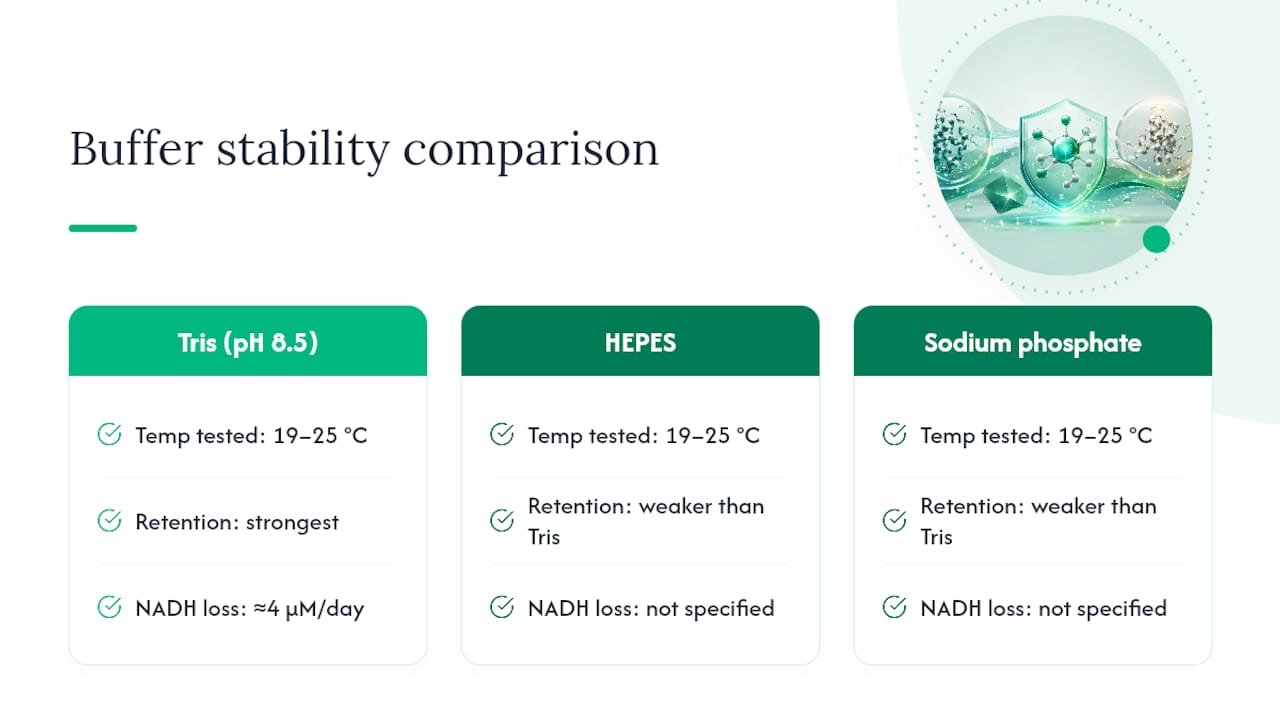
Temperature and pH interact, and treating them as separate variables is a common mistake in early-career protocol design. A 43-day comparison of common laboratory buffers found that NAD+ and NADH held up far better in Tris buffer at pH 8.5 than in HEPES or sodium phosphate at comparable concentrations, with NADH degradation in Tris measured at roughly 4 micromolar per day at 19°C, a rate several times slower than the same cofactor in phosphate-based systems.
NAD+ Stability by Buffer, 43-Day Study: Tris buffer at pH 8.5 preserved NAD+/NADH cofactors far longer than HEPES or sodium phosphate over the same 43-day window, with NADH loss in Tris measured at roughly 4 μM per day at 19°C.
Temperature effects follow the pattern most bench scientists expect, but the actual gap between conditions is larger than intuition suggests. At 37°C, degradation in aqueous solution proceeds on a timescale of days. At room temperature (roughly 25°C), a well-buffered NAD+ solution can often hold usable concentrations for one to a few weeks. At 4°C, some buffer and matrix combinations remain stable for multiple weeks, and manufacturer data indicate neutral to slightly acidic solutions can stay stable at 0°C for at least two weeks. Frozen storage at −20°C or below extends stability into months, and the same supplier documentation reports aqueous aliquots at −70°C remaining stable for at least six months.
Practical pH guidance follows directly from the mechanism:
- Avoid strongly acidic conditions, which accelerate glycosidic bond hydrolysis.
- Avoid strongly alkaline conditions above roughly pH 9, which promote a different set of degradation side reactions.
- Target a slightly basic range, around pH 8 to 8.5, which the Tris data above shows minimizes combined NAD+ and NADH losses better than near-neutral phosphate or HEPES systems.
Note that β-NAD is hygroscopic by nature, so pH control on its own does not solve the problem if humidity control is neglected.
Which Buffer Preserves NAD+ Longest: Tris, HEPES, or Phosphate?
Tris buffer at pH 8.5 is the clear winner among the three most common laboratory buffers for NAD+ retention, based on the 43-day comparison referenced above. HEPES showed comparatively poorer NAD+ retention over the same window, and sodium phosphate performed worst of the three in that study, likely because phosphate ions can catalyze hydrolysis of the nicotinamide-ribose bond under certain conditions rather than simply acting as an inert buffering agent.
That interaction matters for anyone assuming buffer choice is a formality. A phosphate-buffered saline system, common in cell biology workflows, is convenient for downstream assays but is not the best environment for holding NAD+ stock at bench temperature for more than a day or two.
Beyond the three conventional buffers, researchers exploring more exotic stabilization chemistry have tested deep eutectic solvents, or DES, as alternative media. Choline chloride:urea, one of the most studied DES combinations, extended NAD stability up to roughly 50 days in model enzymatic systems, well beyond what any standard aqueous buffer achieved in comparable timeframes. DES chemistry is not yet a routine storage medium for most labs, but it signals where solvent engineering is headed for cofactor preservation.
A related approach, tethering NAD species to thiol-terminated silica nanoparticles, reduced thermal degradation to roughly 15% loss after 12 hours at 100°C, compared with much greater loss for free NAD under the same heat stress. That is a materials-science solution rather than a buffer swap, but it confirms the same underlying principle: immobilizing or shielding the molecule from bulk solvent interaction slows the same hydrolysis and oxidation pathways discussed above.
Practical buffer takeaways for routine work:
- Tris (pH 8.5) is the strongest default choice among conventional buffers for multiweek NAD+ work.
- HEPES is workable for short assays but shows faster measured loss than Tris over extended timeframes.
- Sodium phosphate should be reserved for short-duration steps, given its catalytic hydrolysis risk.
- Deep eutectic solvents are a promising research direction, not yet a routine substitute for standard buffer systems.
Powder vs. Solution: Formulation and Packaging Best Practices
Lyophilized NAD+ powder and reconstituted NAD+ solution follow completely different stability rules, and treating them the same is where most labs lose material. Powder is the stable, archival form. Solution is the working, perishable form, and the transition between the two should be treated as a one-way door for each aliquot.
For lyophilized powder, follow these five practices:
- Store sealed with desiccant. Because β-NAD is hygroscopic, any exposure to ambient humidity begins pulling moisture into the powder, which sets up the same hydrolysis pathway that degrades solutions.
- Choose your freezer tier by purpose. Use −20°C for routine, frequently accessed stock, and reserve −80°C for archival lots you do not plan to touch for months.
- Use amber or light-blocking vials. Even powder benefits from reduced light exposure over long storage periods.
- Minimize headspace on resealing. Extra air volume in a container means more opportunity for moisture cycling every time the vial is opened.
- Label with receipt date and lot number, not just expiration date, so you can correlate any later stability issue with a specific batch.
For reconstituted solution, the rules shift toward speed and single-use discipline:
- Prepare small aliquots immediately after reconstitution, sized for one experiment or one day’s work, never a shared stock bottle.
- Store working aliquots at 2°C to 8°C short-term and plan to use them within days, not weeks.
- Never refreeze and rethaw the same aliquot. Repeated freeze-thaw cycling is one of the most underappreciated sources of silent NAD+ loss in busy labs.
- Match your buffer to your holding time, using Tris at pH 8.5 when a solution needs to survive more than a few days on the bench.
- Track solution age on the tube, not just on a freezer log, since a mislabeled aliquot is the easiest way to introduce silent error into a dataset.
Pro Tip: Run a quick internal comparison the first time you switch buffer systems. Reconstitute two identical aliquots, one in Tris pH 8.5 and one in your current buffer, and measure NAD+ by UV-Vis or HPLC at day 1, day 7, and day 14. The 43-day Tris data are a strong starting point, but your specific matrix, concentration, and storage vessel can shift the curve.
What Do Shipping Studies Show About NAD+ Transit Stability?
Shipping introduces a stability risk that many labs underestimate because it happens outside their own facility, on someone else’s timeline. A simulated shipping study found refrigerated samples held stable across a full 7-day transit window, while room-temperature storage showed measurable losses that extrapolate to roughly 11% at 30 days and 23% at 60 days of continued ambient exposure. That is not a catastrophic collapse over a short domestic shipment, but it is a meaningful erosion for any multi-week international transit or a shipment that sits in a warm loading dock for an extra day.
Use these criteria when deciding how to ship or receive NAD+:
- Dry ice or gel-pack refrigeration for any transit exceeding two to three days, or for shipments crossing climates with hot ground-transport legs.
- Standard ambient shipping is acceptable only for short, one to two day domestic transit windows where the receiving lab processes the material immediately.
- Temperature loggers inside the shipping container for any order where cold-chain integrity is a contractual or research requirement.
- Supplier cold-chain documentation should accompany multi-day shipments, not just a packing slip.
On arrival, three checks take less than fifteen minutes and catch most shipping problems before they contaminate a dataset: confirm the Certificate of Analysis matches the lot received, inspect packaging for signs of thermal excursion such as condensation or a melted gel pack, and, where your lab has the capacity, run a quick HPLC or UV-Vis check on a small aliquot before committing the full shipment to a freezer.
Dried Blood Spot vs. Whole-Blood Extraction for NAD+ Sampling
Collection method determines how much of your measured NAD+ reflects the true biological value versus post-collection enzymatic drift, and this is where the dried blood spot approach earns its reputation among researchers running blood-based NAD+ assays. Coated DMPK-B cards, which carry a stabilizing chemical treatment, maintained NAD+ at roughly 85% or greater for at least two weeks at 4°C and about one week at room temperature, a retention rate that uncoated cards do not match.
DBS Stability Data: Coated DMPK-B cards preserved ≥85% of NAD+ for up to two weeks at 4°C, and the same study found NAD+ in the accompanying blood extraction solution remained above 90% for nearly two months.
The mechanism behind that performance gap is enzymatic, not just physical. Whole blood contains CD38 and PARP enzymes that continue consuming NAD+ after the draw unless something stops them, and DMPK-B coating chemistry works by inactivating or blocking that ongoing enzymatic activity at the point of sample deposition. Whole-blood liquid samples left unprocessed at room temperature give those enzymes far more time and access to act before the eventual assay.
Practical steps for blood-based NAD+ sampling:
- Deposit blood onto a coated card immediately after collection rather than storing liquid whole blood, whenever the assay design allows it.
- Refrigerate the card at 4°C if analysis is more than a few days out, and note that even room temperature holds up for roughly a week per the cited data.
- Extract promptly on your defined timeline, since the coated card buys stability but does not make the sample immortal.
- Log collection-to-extraction time for every sample, since this interval is a real confound in any cross-study comparison of NAD+ values.
A Quick Reference to the Major NAD+ Stability Studies
Four bodies of evidence anchor most of the practical guidance above, and knowing their exact conditions helps you judge whether a finding actually transfers to your own protocol.
The buffer comparison study ran NAD+ and NADH in Tris (pH 8.5), HEPES, and sodium phosphate side by side for 43 days at temperatures around 19°C to 25°C, tracking degradation by chromatographic and spectroscopic assay. Tris consistently outperformed the other two buffers, with NADH degrading at roughly 4 μM per day in that system.
The DBS sampling study tested multiple dried blood spot card chemistries, including uncoated cards and coated DMPK-A and DMPK-B formats, tracking NAD+ retention at 2 days, 1 week, 2 weeks, and 1 month under both 4°C and room-temperature storage. Coated DMPK-B cards showed the strongest retention profile of the formats tested.
The deep eutectic solvent study screened several DES formulations against conventional buffers in model enzymatic systems, identifying choline chloride:urea as the best-performing combination, extending stability to roughly 50 days under the conditions tested. A related nanoparticle-tethering approach showed reduced thermal degradation under acute heat stress, though neither DES nor nanoparticle tethering is yet standard practice outside specialized biocatalysis research.
The shipping simulation study compared refrigerated versus ambient transit conditions over real shipping timeframes, finding stable refrigerated performance across 7 days against a slow, measurable ambient decline projected to roughly 23% loss by 60 days.
How Neolabpeptides Documents NAD+ Quality for Every Batch
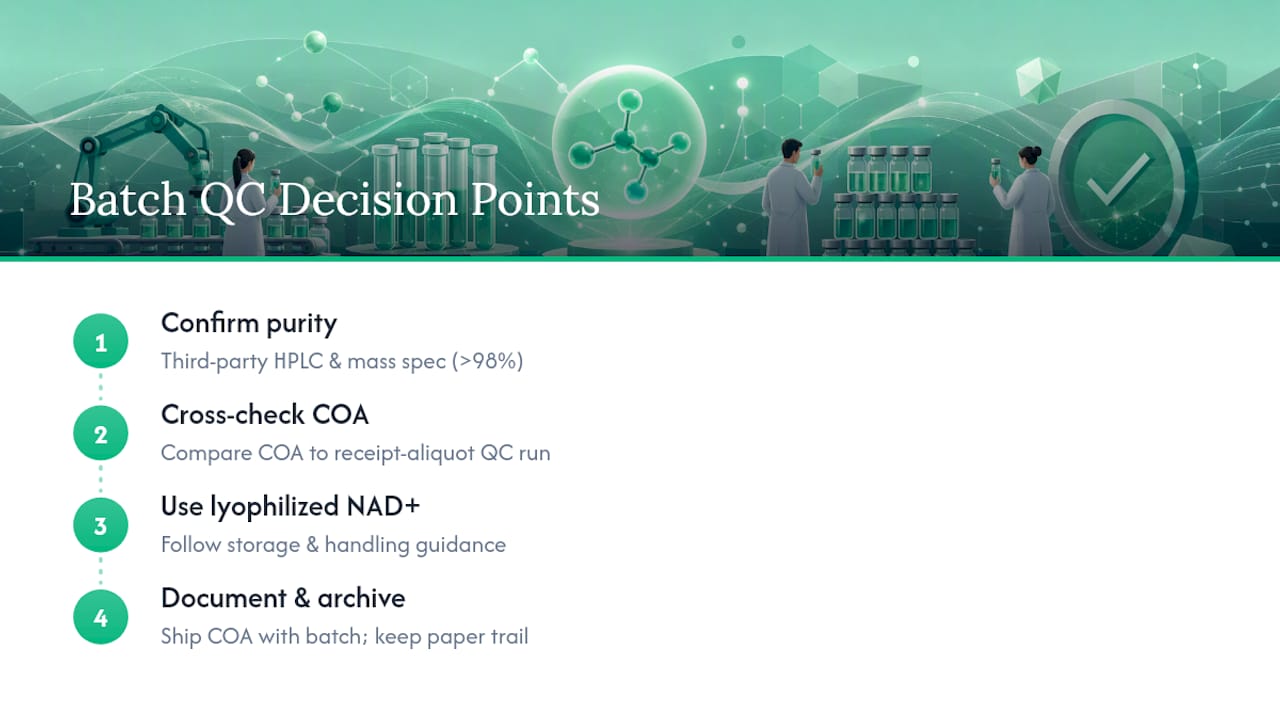
Reproducibility in NAD+ research depends on knowing exactly what arrived in the vial, not just trusting a label. Neolabpeptides verifies NAD+ purity above 98% through third-party HPLC and mass spectrometry testing, and every batch ships with a Certificate of Analysis so your lab has a documented reference point before the material ever reaches a freezer.
That documentation matters most at the exact decision points this article covers: confirming purity before you commit a shipment to long-term storage, cross-checking a COA against your own receipt-aliquot QC run, and having a paper trail if a stability question comes up months into a study. Neolabpeptides supplies NAD+ in lyophilized form, which aligns with the archival storage practices outlined above, and pairs it with storage and handling guidance for lyophilized compounds that translates directly to the desiccation and cold-chain steps this article recommends.
For labs building out a broader stability protocol, Neolabpeptides also documents peptide storage practices relevant to aliquoting and humidity control across compound classes, giving researchers a consistent reference framework rather than reinventing SOPs for every new reagent that enters the freezer.
A Receiving and Storage Checklist for NAD+
A short, disciplined intake and storage routine catches most stability problems before they ever touch an experiment.
- Confirm the Certificate of Analysis matches the lot number on the shipment, and file it alongside your inventory record, not separately.
- Inspect packaging on arrival for condensation, warmth, or a spent gel pack, which signal a possible cold-chain break in transit.
- Run a quick QC check when feasible, using HPLC or UV-Vis on a small aliquot, especially for any shipment that crossed more than a two-day transit window.
- Store lyophilized powder sealed with desiccant at −20°C for routine access or −80°C for archival lots you will not touch for months.
- Aliquot immediately upon first reconstitution, sizing each tube for a single experiment or a single day’s use.
- Hold working solution at 2°C to 8°C and plan to consume it within days, favoring Tris buffer at pH 8.5 if you need it to last closer to two weeks.
- Never refreeze a thawed aliquot. Log each freeze-thaw event if a tube must be reused, and treat any tube with more than one cycle as reduced confidence stock.
- Set a QC retest interval, particularly for solutions held longer than two weeks, and retire any stock showing discoloration, unexpected precipitate, or a failed spot-check assay.
Pro Tip: Keep a simple shared spreadsheet logging reconstitution date, buffer, storage temperature, and freeze-thaw count for every working NAD+ aliquot in the lab. Most “unexplained” assay variability traces back to one of those four variables once someone actually checks the log.
Notes From the Bench on What Actually Trips Up NAD+ Work
The most common mistake I see in NAD+ handling is not a dramatic freezer failure. It is slow humidity creep from a poorly sealed powder container and one too many freeze-thaw cycles on a “just this once” basis. Both are boring, and both quietly wreck datasets over weeks. Run a small validation experiment in your own buffer and vessel before trusting published timeframes wholesale. Conditions in the cited studies are a strong starting point, not a guarantee for your exact setup. If your lab has generated its own stability data on NAD+ handling, that kind of shared protocol calibration is worth more to the field than another generic storage guide.
— Stephan
Get Research-Grade NAD+ With Documentation Built for Reproducibility
Neolabpeptides supplies research-grade NAD+ at verified purity above 98%, tested by HPLC and mass spectrometry, with a Certificate of Analysis included on every order. That means you are not starting your stability protocol blind. You know the purity baseline before your first storage test, which is the exact starting point this article’s SOP checklist assumes.

If you are validating a new buffer system or setting up a DBS sampling workflow, ordering a smaller aliquot first is the practical move: confirm handling and QC results in your own lab conditions before scaling to a full study order. Review the NAD+ 1000mg research-grade product listing for current specifications and COA access, or reach out to Neolabpeptides technical support with questions about lot documentation before you place an order through the Neolabpeptides storefront.
Sources
- Stabilization and quantitative measurement of nicotinamide adenine dinucleotide in human whole blood using dried blood spot sampling
- Long-Term Stability of Nicotinamide Cofactors in Common Aqueous Buffers: Implications for Cell-Free Biocatalysis
- Mechanism behind coenzyme stabilisation effect — stabilization of NAD by deep eutectic solvents
- N8285 product information sheet (β-NAD) — storage/stability