

GLP-1 Analogs Research: Mechanisms, Trials, and Next-Gen Agents
Peptide GLP-1 receptor agonists reliably lower HbA1c and produce clinically meaningful weight loss, and several agents carry demonstrated cardiovascular and renal benefit. GLP-1 analogs research is now shifting hard toward three fronts: oral small molecules (orforglipron, aleniglipron), multi-agonist peptides (tirzepatide, retatrutide), and mechanism-biased ligands like ecnoglutide, designed to separate efficacy from tolerability.
The trial data are consistent on a few points:
- Peptide GLP-1RAs improve glycemic control and drive dose-dependent weight loss across phase 2/3 programs.
- Cardiovascular and renal outcome data support a protective effect in relevant populations.
- Gastrointestinal adverse events during dose titration remain the dominant tolerability constraint across the class.
In one phase 3 trial, orforglipron reduced HbA1c by up to 1.48 percentage points over 40 weeks with dose-related weight loss, evidence that oral small molecules can approach the efficacy ceiling set by injectable peptides. That single data point is reshaping how research teams prioritize which agents merit head-to-head study.
Key Takeaways
GLP-1 analogs research confirms consistent glycemic and weight-loss benefits for the peptide class while shifting its center of gravity toward oral small molecules and multi-agonist peptides.
| Point | Details |
|---|---|
| Signaling bias shapes outcomes | cAMP-biased ligands like ecnoglutide may separate efficacy from GI tolerability more than balanced agonists. |
| Oral agents are closing the gap | Orforglipron achieved HbA1c reductions up to 1.48 percentage points, rivaling early peptide data. |
| Titration schedule controls tolerability | Slower dose escalation reduces GI-driven discontinuation across phase trials. |
| Long-term oral data remain sparse | Head-to-head cardiovascular and renal outcome trials for newer oral agents don’t yet exist. |
| Multi-agonists are the growth frontier | GIP and glucagon co-agonism in tirzepatide and retatrutide point toward greater weight-loss efficacy. |
| Purity affects experimental validity | Research-grade GLP-1 analogs from Neo Lab Peptides come with HPLC/MS verification above 98% and a Certificate of Analysis for reproducible lab work. |
Table of Contents
- What Does GLP-1 Analogs Research Reveal About Receptor Signaling?
- How Effective Are GLP-1 Analogs in Clinical Trials?
- What Safety Signals Should Researchers Monitor During Trials?
- Injectable Peptides vs. Oral Small Molecules: Which PK Profile Fits Your Study?
- Where Is GLP-1 Analogs Research Headed Next?
- Designing Better GLP-1 Receptor Research: Models and Readouts
- Why Signaling Bias Deserves More Attention Than It Gets
- Get Research-Grade GLP-1 Analogs for Your Lab
- Frequently Asked Questions About GLP-1 Analogs Research
- Sources
What Does GLP-1 Analogs Research Reveal About Receptor Signaling?
GLP-1R is a class B G-protein-coupled receptor (GPCR), and its canonical signaling cascade runs through Gs protein activation, adenylyl cyclase, and a rise in intracellular cAMP. That cAMP surge activates protein kinase A (PKA) and exchange protein activated by cAMP (EPAC), which together potentiate glucose-stimulated insulin secretion in pancreatic beta cells and slow gastric emptying. This dual action, more insulin when glucose is elevated, less food moving through the gut, is why the class produces both glycemic and weight effects from a single receptor target.
What complicates interpretation is signaling bias. Not every ligand that binds GLP-1R produces the same downstream signature. Some analogs are cAMP-biased, meaning they favor the classical Gs pathway with comparatively less β-arrestin recruitment. Others recruit β-arrestin more readily, which drives receptor internalization and can blunt sustained signaling. Mechanistic reviews of GLP-1R signaling argue this distinction matters clinically: cAMP-biased compounds may sustain insulinotropic activity while producing a different GI tolerability profile than balanced or β-arrestin-biased agonists.
There’s a second layer researchers often overlook: dose-dependent circuit versus endocrine signaling. At low doses, GLP-1 analogs appear to act largely through vagal afferent circuits, a form of local, neurally mediated signaling. At higher doses, the endocrine mode dominates, with the peptide acting more broadly through systemic receptor engagement. Experimental designs that don’t account for this dose-response shift risk misattributing a circuit-driven effect to endocrine action, or vice versa, which can distort conclusions about mechanism in both rodent studies and early-phase human trials.
- Gs-coupled cAMP signaling drives the core insulinotropic and gastric-motility effects.
- Signaling bias (cAMP-biased vs. β-arrestin-biased) may separate efficacy from GI-related discontinuation.
- Circuit-based (vagal) signaling dominates at low doses; endocrine signaling dominates at high doses.
Pro Tip: When designing dose-response experiments, run at least three dose tiers spanning the expected circuit-to-endocrine transition. A two-point comparison can’t distinguish a genuine mechanistic shift from simple assay noise.
How Effective Are GLP-1 Analogs in Clinical Trials?
The class-level evidence for glycemic control and weight loss is about as strong as anything in metabolic pharmacology, but the effect sizes vary meaningfully by agent, dose, and trial duration. High-quality systematic reviews conclude that GLP-1 receptor agonists as a class reduce major adverse cardiovascular events and slow renal function decline in at-risk populations, while newer multi-agonists and oral agents represent the primary direction of active research investment.
Individual trial data give the sharpest picture of GLP-1 analogs effectiveness:
- Orforglipron, an oral small-molecule GLP-1 receptor agonist, produced HbA1c reductions up to 1.48 percentage points versus placebo over 40 weeks in early type 2 diabetes, with dose-related weight loss and mostly mild-to-moderate GI adverse events.
- Ecnoglutide, a cAMP-biased peptide analog, showed substantial HbA1c reductions and weight loss in its phase 3 EECOH-1 program, direct clinical support for the idea that signaling bias translates into therapeutic performance.
- Aleniglipron, another oral small molecule, produced clinically meaningful weight reductions in a 36-week phase 2b trial, reinforcing that oral agents can deliver competitive efficacy without an injection device.
A broader review of GLP-1 analog research confirms these are not isolated findings. Semaglutide, tirzepatide, and ecnoglutide collectively demonstrate efficacy for glycemic and weight outcomes alongside cardiovascular and renal benefit, and the same body of work notes active exploration into indications well outside metabolic disease.
The gap worth flagging for anyone designing a research program: long-term, head-to-head outcome trials for the newest oral agents and multi-agonists barely exist yet. Most orforglipron and aleniglipron data run 36 to 40 weeks. Cardiovascular and renal outcome trials, the kind that took years to mature for semaglutide and tirzepatide, haven’t been completed for the oral small molecules. Anyone citing “class effects” for these newer compounds should flag that inference as extrapolated, not directly demonstrated.
What Safety Signals Should Researchers Monitor During Trials?
Gastrointestinal adverse events, nausea, vomiting, diarrhea, are the most consistently reported issue across GLP-1 analog trials, and they cluster heavily in the dose-escalation window rather than at steady-state maintenance dosing. Regulatory and reference guidance on this drug class consistently flags GI tolerability as the primary driver of discontinuation, alongside rarer but serious concerns like pancreatitis and gallbladder events that warrant monitoring in longer studies.
Careful titration schedules materially change the tolerability picture. Research on dose-escalation strategy indicates that trials achieving high efficacy while limiting GI-driven dropout typically used slower, stepwise dose increases rather than jumping to target dose. That single design choice appears to separate well-tolerated protocols from those with elevated discontinuation.
For trial and protocol design, a few monitoring practices are worth building in from the start:
- Grade GI adverse events using a standardized scale at every titration step, not just at study endpoints.
- Track discontinuation timing relative to dose changes, so GI-driven dropout can be distinguished from unrelated attrition.
- Monitor lipase/amylase and gallbladder-related symptoms in trials extending beyond 24 weeks.
- Pre-specify stopping and dose-hold criteria tied to AE severity, not just investigator judgment.
- Reference FDA guidance on endpoint and safety reporting when structuring adverse event capture and reporting cadence.
Injectable Peptides vs. Oral Small Molecules: Which PK Profile Fits Your Study?
Long-acting injectable GLP-1 peptides rely heavily on lipidation and other half-life-extension chemistry to enable once-weekly dosing, a pharmacokinetic strategy that trades formulation complexity for dosing convenience. Oral small molecules face the opposite problem: gut bioavailability is the bottleneck, not half-life, which is why agents like orforglipron and aleniglipron are dosed daily rather than weekly.
The efficacy data from both oral candidates suggest bioavailability constraints haven’t capped therapeutic potential. Orforglipron’s phase 3 HbA1c and weight-loss results and aleniglipron’s phase 2b weight reduction findings both land in a range competitive with early injectable peptide data, even with daily rather than weekly administration.
For translational and lab-based research, the delivery format shapes practical decisions:
- Lyophilized peptide stock requires reconstitution protocols and stability monitoring that oral small molecules don’t.
- Daily oral dosing schedules demand different PK/PD sampling windows than once-weekly injectable regimens.
- Assay timing for cAMP or β-arrestin readouts should align with each compound’s known time-to-peak plasma concentration, not a generic sampling schedule borrowed from another agent class.
Where Is GLP-1 Analogs Research Headed Next?
Multi-agonist peptides are the clearest growth area in the field right now. Dual and triple receptor agonists combining GLP-1 with GIP, glucagon, or both are expected to outperform selective GLP-1 agents on weight loss, and early tirzepatide and retatrutide data support that trajectory. The logic is additive receptor engagement: GIP co-agonism appears to enhance insulin sensitivity through a separate pathway, while glucagon co-agonism adds an energy-expenditure component that GLP-1 alone doesn’t provide.

Non-metabolic indications are the more speculative but genuinely active frontier. The same broad review documenting GLP-1 analog benefits for cardiovascular and renal outcomes also notes research expanding into neurodegenerative disease and substance use disorders. That evidence is early, largely mechanistic and observational rather than confirmatory, but it’s driving real trial design activity.
Priority biomarkers and endpoints for translational studies worth tracking:
- Hepatic fat fraction by MRI-PDFF, relevant given emerging interest in MASH (metabolic dysfunction-associated steatohepatitis) as an indication.
- Urinary albumin-to-creatinine ratio for renal outcome signals in shorter studies that can’t wait for hard renal endpoints.
- Cognitive and behavioral measures for neurodegeneration and substance-use hypotheses, an area still lacking standardized endpoints.
- β-arrestin recruitment and receptor internalization assays to validate signaling bias claims in vitro before advancing a compound.
Designing Better GLP-1 Receptor Research: Models and Readouts
Choosing the right preclinical model depends entirely on which mechanism you’re isolating. Rodent behavioral paradigms (conditioned taste aversion, food intake assays) help separate circuit-mediated appetite suppression from direct endocrine effects. Islet perifusion systems isolate insulinotropic potency without the confound of gastric motility. Gastric-emptying assays, meanwhile, directly test the motility arm of GLP-1R signaling that’s often assumed rather than measured.
For in vitro characterization, three readouts matter most:
- cAMP accumulation assays to quantify canonical Gs-pathway activation.
- β-arrestin recruitment assays (BRET or PathHunter-based) to profile signaling bias.
- Receptor internalization kinetics paired with PK sampling windows matched to each compound’s absorption profile, whether injectable or oral.
Pro Tip: Run cAMP and β-arrestin assays on the same batch of peptide used in your in vivo dosing. Purity variance between batches can shift bias profiles enough to confound a signaling-bias comparison.
That batch-consistency concern is exactly why sourcing matters. Neo Lab Peptides supplies GLP-1 analogs at greater than 98% purity verified by HPLC and mass spectrometry, with a Certificate of Analysis accompanying every lot, fast US shipping, and clear research-use-only labeling on all products.
Why Signaling Bias Deserves More Attention Than It Gets
Most coverage of GLP-1 analogs research treats the field as a horse race: which agent hits the biggest weight-loss number. That framing misses what actually determines whether a compound survives phase 3. The ecnoglutide and orforglipron data both point to the same underlying story, that receptor-level signaling bias, not just binding affinity or half-life, is what separates a well-tolerated agent from one that hemorrhages patients during titration.
The conventional advice, “titrate slowly and you’ll manage GI events,” is true but incomplete. It treats tolerability as purely a dosing problem when the evidence increasingly suggests it’s also a ligand-design problem. Researchers who ignore signaling bias in early compound screening are betting on titration schedules to fix what molecular design could address earlier.
If you’re prioritizing what to study first, put in vitro bias profiling ahead of large-scale efficacy trials. It’s cheaper, faster, and the aleniglipron and ecnoglutide programs suggest it predicts clinical performance better than most researchers currently assume.
Get Research-Grade GLP-1 Analogs for Your Lab
The mechanistic and clinical questions covered here, signaling bias, dose-dependent circuit versus endocrine effects, oral versus injectable PK, all depend on one non-negotiable input: peptide purity you can trust batch to batch. Inconsistent purity doesn’t just weaken your data, it can quietly shift a signaling-bias comparison in either direction without you noticing.

Neolabpeptides supplies GLP-1 analogs and related research peptides at greater than 98% purity, independently verified through HPLC and mass spectrometry, with a Certificate of Analysis included on every order. The catalog covers single agonists like semaglutide alongside dual and triple incretin peptides such as tirzepatide and retatrutide, giving researchers a consistent supply chain across an entire experimental program rather than sourcing different agents from different vendors. All products ship fast within the US and are labeled strictly for research use, never for human or veterinary administration. If your next protocol calls for verified-purity GLP-1 analogs, browse the current research peptide catalog and get your Certificate of Analysis with your order.
Frequently Asked Questions About GLP-1 Analogs Research
What are the main types of GLP-1 analogs studied in current research?
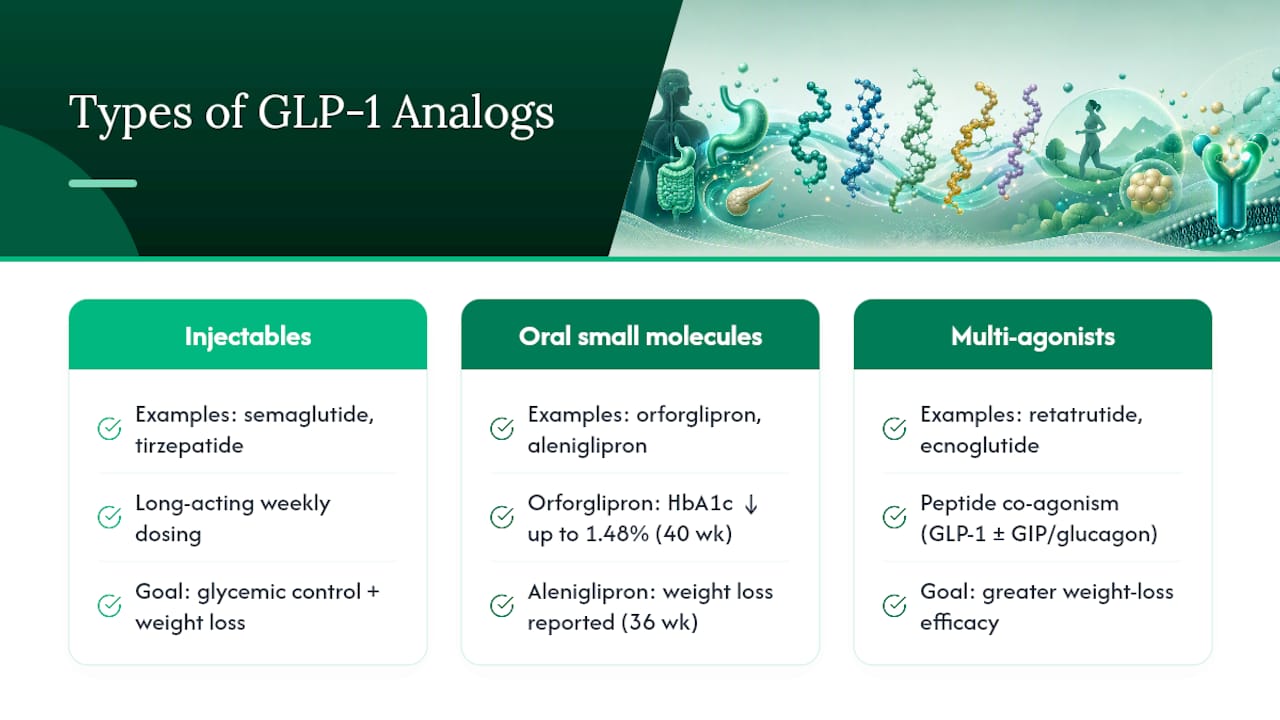
Current GLP-1 analogs research spans injectable peptides (semaglutide, tirzepatide), oral small molecules (orforglipron, aleniglipron), and mechanism-biased or multi-agonist compounds (ecnoglutide, retatrutide). Each category targets a different translational goal, from long-acting weekly dosing to daily oral accessibility to signaling-bias optimization.
How do GLP-1 analogs work at the receptor level?
GLP-1 analogs bind GLP-1R, a class B GPCR, activating Gs protein signaling that raises intracellular cAMP and engages PKA and EPAC. This cascade increases glucose-stimulated insulin secretion and slows gastric emptying, and the strength of each effect can vary depending on a given ligand’s signaling bias.
Are oral GLP-1 small molecules as effective as injectable peptides?
Early phase data suggest they can be competitive. Orforglipron produced HbA1c reductions up to 1.48 percentage points over 40 weeks, and aleniglipron showed clinically meaningful weight loss in a 36-week trial. Long-term outcome data comparable to what exists for injectable peptides are still pending.
What is the biggest safety concern in GLP-1 analog trials?
Gastrointestinal adverse events, primarily nausea, vomiting, and diarrhea during dose escalation, are the most common issue and the leading driver of trial discontinuation. Slower titration schedules consistently reduce this risk across published trial designs.
Why are multi-agonist peptides considered the next major research direction?
Adding GIP or glucagon co-agonism to a GLP-1 backbone appears to increase weight-loss efficacy beyond what selective GLP-1 agonists achieve alone, based on emerging tirzepatide and retatrutide data. This makes multi-agonists a dominant focus in current GLP-1 analogs research and comparison studies.
This article is general information, not a substitute for advice from a qualified doctor. Consult a qualified healthcare professional about your own circumstances before acting on anything here.
Sources
- Orforglipron, an Oral Small‑Molecule GLP‑1 Receptor Agonist, in Early Type 2 Diabetes
- Ecnoglutide phase 3 trial (EECOH-1) — Nature Communications
- Mechanistic reviews of GLP‑1 receptor signaling and dose-dependent modalities
- GLP‑1 receptor agonists and next‑generation incretin medications: metabolic, cardiovascular, and renal benefits — The Lancet