

Cold Chain Shipping for Research-Grade Peptides
Shipping peptides safely requires a validated, temperature-controlled pack-out matched to the compound’s physical state, combined with documented chain-of-custody from origin to recipient. The cold chain logistics framework used in pharmaceutical distribution applies directly here, with three immediate steps: (1) select your pack-out based on whether the peptide is lyophilized, reconstituted, or lipidated; (2) book an expedited carrier service with a guaranteed transit window; (3) include a calibrated data logger and the product’s Certificate of Analysis (COA) inside every shipment.
- Lyophilized peptides tolerate short ambient transit (typically under 24–48 hours) when properly sealed, though refrigerated shipping is still preferred for multi-day routes or warm-season conditions.
- Reconstituted peptides degrade within days at room temperature and require 2–8 °C or frozen transport with overnight service as the default.
- Lipidated or modified peptides often carry specific stability constraints; always defer to the manufacturer’s documented storage instructions before selecting a temperature target.
Pro Tip: Never assume ambient shipping is acceptable for a reconstituted peptide based on lyophilized-form guidance. The physical state changes the degradation kinetics entirely.
Key Takeaways
Validated pack-out selection, compound-specific temperature targeting, and documented chain-of-custody are the three non-negotiable requirements for maintaining peptide integrity during transport.
| Point | Details |
|---|---|
| Match temperature to physical state | Reconstituted peptides require 2–8 °C or frozen transit; lyophilized peptides tolerate short ambient exposure but benefit from refrigerated shipping. |
| Use PCMs or gel packs for 2–8 °C | Dry ice risks freezing chilled payloads and adds Class 9 DG compliance; PCMs and pre-conditioned gel packs are the correct choice for refrigerated shipments. |
| Validate before you ship at scale | Run thermal profiling on your riskiest lane using calibrated data loggers; document acceptance criteria and retain records for audit. |
| Document every shipment | COA, chain-of-custody form, temperature log, and carrier tracking confirmation constitute the minimum audit-ready shipping record. |
| Neolabpeptides ships lyophilized with COA | All products ship in lyophilized form with third-party HPLC/MS-verified COAs, giving labs the documentation and stability margin needed for a defensible cold-chain record. |
Table of Contents
- Why cold chain shipping for peptides is non-negotiable
- How to determine the correct temperature for a specific peptide
- Packaging and process choices that protect your peptide in transit
- Regulatory, labeling, and documentation requirements for U.S. peptide shipments
- How to validate packaging and qualify a peptide shipping workflow
- Choosing carriers and service levels for U.S. peptide transport
- Scaling from ad hoc shipments to recurring peptide distribution
- What to expect from a research peptide supplier’s cold-chain practices
- How seasonal variations and geography affect your shipment
- Environmental and sustainability considerations in cold chain packaging
- The operational mistakes that actually compromise peptide shipments
- Research-grade peptides with cold-chain documentation, ready to ship
- Sources
Why cold chain shipping for peptides is non-negotiable
Peptides are susceptible to three primary degradation pathways during transit: hydrolysis (peptide bond cleavage accelerated by heat and moisture), oxidation (affecting methionine, cysteine, and tryptophan residues), and aggregation (irreversible self-association at elevated temperatures). Residual moisture in lyophilized preparations amplifies all three mechanisms when temperature control fails.
The industry maps temperature requirements to three operational bands:
| Temperature Band | Typical Use Case | Payload Type | Recommended Transit Window |
|---|---|---|---|
| 2–8 °C | Short-term storage, refrigerated transit | Lyophilized or reconstituted | Up to 24–48 hours with validated pack-out |
| −20 °C | Standard frozen storage and shipping | Lyophilized, reconstituted (frozen) | Up to 48 hours with dry ice or deep-freeze PCM |
| −78.5 °C | Ultra-cold long-term storage | Sensitive reconstituted, modified peptides | Overnight only; dry ice mandatory |
The CDC’s vaccine storage and handling guidance establishes 2–8 °C as the practical standard for refrigerated biologics, with continuous temperature monitoring as a baseline expectation. Labs shipping research peptides can adapt these same operational standards directly. Lyophilized peptides tolerate short ambient exposure, but reconstituted solutions degrade measurably within days at room temperature, making the temperature band selection a compound-specific decision, not a default.
How to determine the correct temperature for a specific peptide
No single temperature applies universally. Use this decision checklist before every shipment:
- Review the COA and stability data. The COA from your supplier should specify recommended storage conditions. If stability data is available, use it to confirm the acceptable temperature range for the transit duration you are planning.
- Identify the physical state. Lyophilized peptides have broader tolerance; reconstituted solutions require tighter control. Consult reconstitution and handling guides for compound-specific protocols.
- Check for chemical modifications. Lipidated, PEGylated, or otherwise modified peptides often have distinct thermal stability profiles. Manufacturer documentation takes precedence over generic rules.
- Confirm freeze/thaw sensitivity. Some peptides lose activity after a single freeze/thaw cycle. If the compound is sensitive, avoid dry ice for 2–8 °C payloads, since sublimation can cause localized freezing.
- Apply beyond-use dating (BUD) principles. For reconstituted preparations, USP’s BUD guidance and USPNF compounding standards define how storage conditions affect the usable window after preparation.
- Consult FDA labeling when applicable. For peptides with approved drug analogs, FDA drug labels provide molecule-specific storage and handling instructions that can inform research-grade handling decisions.
When vendor guidance conflicts with a generic rule, vendor guidance wins. Request documented stability data or validated storage instructions from your supplier for any high-value or time-sensitive shipment.
Pro Tip: The minimum documentation to request from any supplier before shipping: a COA with storage conditions, a stability summary or validated storage instruction sheet, and the recommended reconstitution protocol if the peptide will be used in solution form.
Packaging and process choices that protect your peptide in transit
Coolant and insulation options by temperature band
Choosing the right coolant is the single most consequential pack-out decision. PCMs and gel packs are the preferred choice for 2–8 °C shipments because they hold a plateaued temperature without the freeze risk or hazmat requirements that dry ice introduces. Dry ice maintains approximately −78.5 °C and is necessary for ultra-cold payloads, but it adds Class 9 dangerous goods (DG) compliance requirements that complicate carrier booking and documentation.
| Coolant / Insulation | Temperature Range | Payload Size | Transit Profile | Validation Support |
|---|---|---|---|---|
| Gel packs (pre-conditioned) | 2–8 °C | Small to medium vials | Up to 48 hours | Thermal profiling available |
| Phase-change materials (PCM) | 2–8 °C or −20 °C (PCM-specific) | Small to large | 48 hours | ISTA-compatible; reusable |
| Dry ice | −78.5 °C (sublimation point) | Any | 24–48 hours (weight-dependent) | Requires DG documentation |
| Vacuum-insulated panels (VIP) | 2–8 °C or frozen | Medium to large | 72 hours | High-performance; reusable |
| EPS foam with gel packs | 2–8 °C | Small | Up to 24 hours | Basic; single-use |
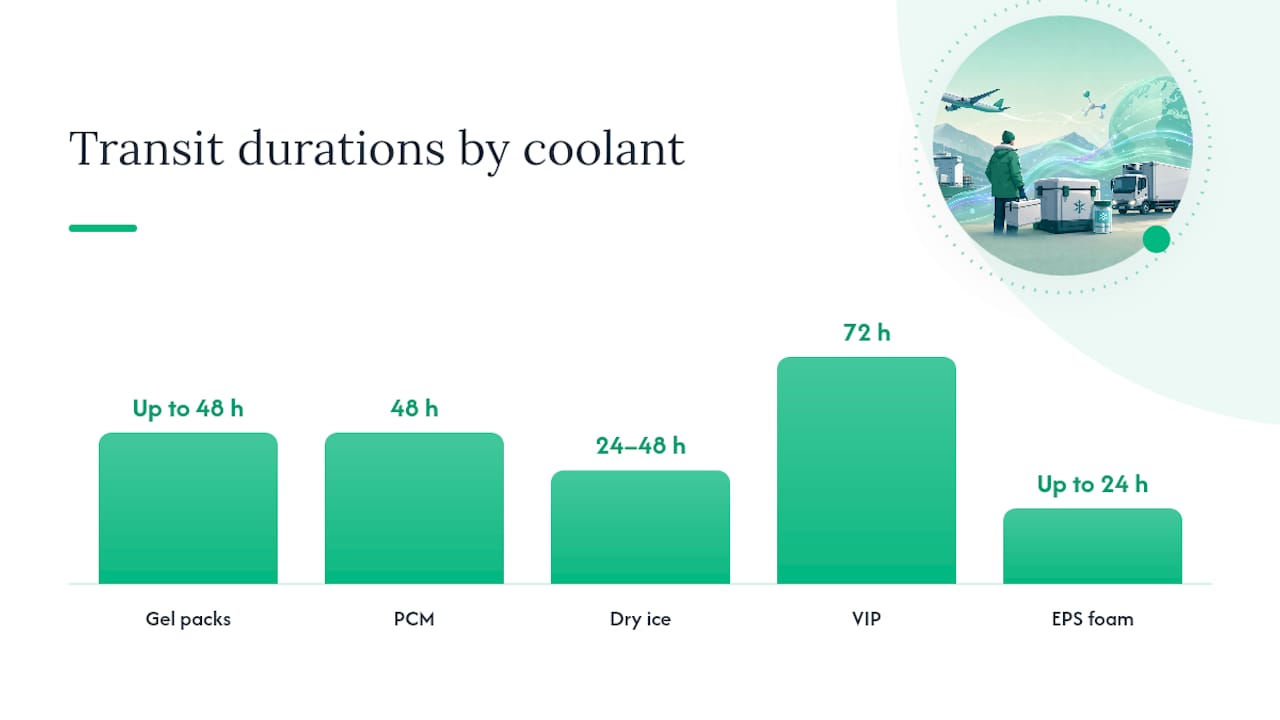
Dry Ice Corp’s operational guidance confirms that dry ice is often unnecessary for 2–8 °C shipments and that gel packs maintain chilled temperatures without triggering DG labeling requirements. For multi-day refrigerated routes, reusable VIP plus PCM systems frequently outperform single-use EPS expendables on excursion rates.
Packing sequence and payload preparation
Follow this sequence for every pack-out:
- Pre-condition all refrigerants to the target temperature at least 12–24 hours before packing.
- Place a desiccant sachet alongside lyophilized vials to manage residual moisture.
- Wrap individual vials in bubble wrap or foam to prevent breakage; never allow glass-to-glass contact.
- Position the calibrated data logger at the geometric center of the payload, not against the coolant.
- Seal the payload compartment before adding outer coolant layers.
- Close and tape the insulated shipper; apply all required labels before handing to the carrier.
Dry ice operational notes
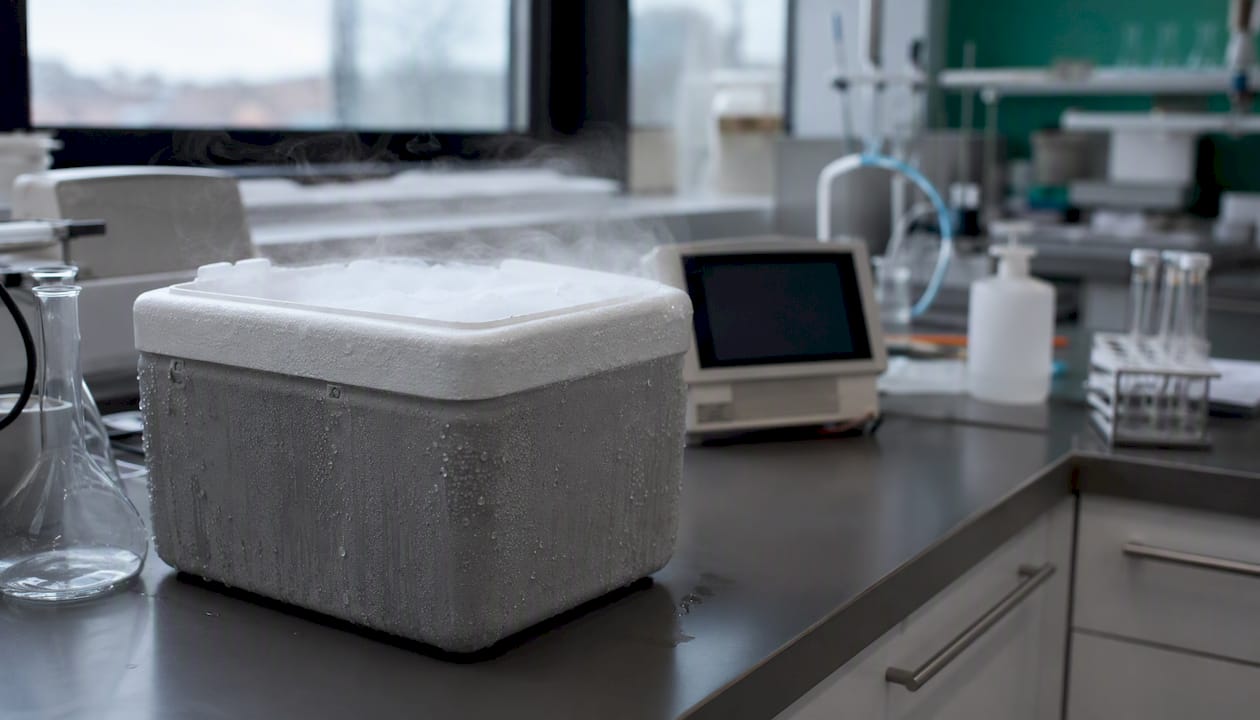
Air shipments using dry ice must carry UN1845 marking, state the net dry-ice weight in kilograms, and display Class 9 labeling per IATA PI 954 requirements. Ground shipments follow DOT 49 CFR Part 173 for dry ice quantities above 2.5 kg. Dry ice sublimates at roughly 5–10 lbs per 24 hours in a standard EPS shipper, so calculate the required quantity against your transit window with a margin for delays.
Regulatory, labeling, and documentation requirements for U.S. peptide shipments
Every peptide shipment needs a documented paper trail. The minimum required set:
- Certificate of Analysis (COA): Confirms purity, identity (HPLC and mass spectrometry results), and storage conditions. Include a copy inside the shipment and retain one on file.
- Chain-of-custody record: Documents who packed the shipment, when, at what temperature, and who received it. A simple form with timestamps satisfies most research-use requirements.
- Temperature log: Data logger report showing the full transit thermal profile. Attach to the chain-of-custody record after delivery.
- SOP reference: Note which validated pack-out SOP was used for this shipment.
- Dry-ice declaration (if applicable): UN1845, net kg, Class 9 label, and shipper’s DG declaration for air transport.
- Customs documentation (international): Commercial invoice, HS code, and research-use declaration for cross-border moves.
For record retention, maintain all shipping documentation for a minimum of two years or in line with your institution’s research records policy. An audit-ready shipping folder contains the COA, chain-of-custody form, data logger report, carrier tracking confirmation, and the pack-out SOP used.
Statistic callout: 3PL operators handling research peptides consistently cite continuous temperature monitoring and validated pack-outs as the two most critical infrastructure requirements for maintaining peptide integrity across transit.
How to validate packaging and qualify a peptide shipping workflow
A qualified shipping workflow is one where documented evidence confirms the pack-out maintains the target temperature range across the worst-case route and season. The validation sequence:
- Design qualification (DQ): Confirm the pack-out components (insulation type, coolant type and quantity, data logger model) are specified in writing and match the intended temperature band.
- Installation qualification (IQ): Verify that refrigerants are pre-conditioned correctly and that the pack-out is assembled per the written SOP.
- Performance qualification (PQ): Run thermal profiling studies using calibrated data loggers. Test at least three replicate shipments on the target route. Include worst-case seasonal conditions (peak summer heat, winter cold).
- Acceptance criteria: The payload temperature must remain within the target band for the full transit window plus a defined buffer (typically 4–6 hours beyond the expected delivery time).
- ISTA benchmarking: ISTA 7D and related protocols provide standardized test conditions for temperature-controlled shipping systems. Referencing ISTA compliance in your SOP adds credibility for institutional or regulatory review.
Data logger specifications that support a defensible validation:
- Sampling interval: 5–15 minutes
- Accuracy: ±0.5 °C or better
- Calibration: NIST-traceable, with calibration certificate on file
- Placement: geometric center of the payload mass, away from coolant surfaces
Pro Tip: Run your first validation on the riskiest lane (longest transit, highest ambient temperature exposure) rather than the easiest one. A pack-out that passes the worst case covers everything else by default.
Choosing carriers and service levels for U.S. peptide transport
Carrier selection is as consequential as pack-out design. A validated pack-out fails if the carrier mishandles the shipment or misses the delivery window.
Key carrier selection criteria:
- Guaranteed transit time: Overnight (next-business-day) is the standard for reconstituted peptides. Two-day service is acceptable for lyophilized peptides in validated pack-outs with sufficient coolant capacity.
- Temperature-enabled services: Some national carriers offer temperature-controlled freight lanes. Confirm whether the service includes active temperature management or relies on passive pack-out performance.
- Dry-ice handling capability: Not all carrier facilities are equipped to handle Class 9 DG shipments. Confirm DG acceptance and staff training before booking.
- Weekend and holiday handling: Avoid shipping on Thursdays or Fridays unless the carrier offers Saturday delivery. A shipment that sits in a hub over a weekend is a high-excursion risk.
- Last-mile control: For local or regional deliveries, a dedicated courier with direct handoff to the recipient reduces handling events and excursion risk.
- Claims process and declared value: Confirm the carrier’s claims procedure for temperature-sensitive shipments and declare the shipment value accurately to protect against loss.
For reconstituted peptides, overnight service is the default. Lyophilized peptides shipped in a validated VIP or PCM pack-out can tolerate two-day service on most domestic U.S. routes, provided the pack-out has been qualified for that transit window.
Scaling from ad hoc shipments to recurring peptide distribution
Moving from occasional research shipments to a recurring or high-volume distribution workflow introduces cost and risk trade-offs that require deliberate planning.
Operational levers for scaling:
- Reusable VIP and PCM programs: Reusable insulated shippers reduce per-shipment packaging cost significantly over time. Establish a return-and-recondition cycle with your logistics partner.
- Negotiated carrier SLAs: Volume commitments with a national carrier can secure guaranteed transit times, priority handling, and dedicated account support.
- Route engineering: Analyze historical excursion data by lane. Reroute high-excursion lanes to carriers with better last-mile performance or switch to active refrigerated transport for those routes.
- Centralized staging: Pre-stage pre-conditioned pack-outs at a central fulfillment point rather than assembling them at the bench. This reduces variability and supports SOP compliance.
Cost vs. risk trade-offs are most visible when comparing passive and active systems. Active refrigerated transport (temperature-controlled vehicles or containers) is justified for high-value, high-volume routes where excursion costs exceed the premium. For most research-scale shipments, a validated passive system with overnight service is the more practical choice. Use the peptide price tool to factor shipping costs into your total landed cost estimate.
Contingency planning should include buffer stock policies for high-use compounds, documented seasonal pack-out variations (heavier coolant loads in summer, freeze-protection measures in winter), and a clear supplier communication protocol for delayed or excursion-flagged shipments.
What to expect from a research peptide supplier’s cold-chain practices
A supplier’s cold-chain practices are as important as your own. When evaluating or ordering from a research peptide supplier, the documentation and operational standards they provide directly affect the integrity of what arrives at your lab.
Neolabpeptides provides the following with every order:
- Certificate of Analysis (COA): Each product ships with a COA confirming identity and purity, verified by third-party HPLC and mass spectrometry testing to 98%+ purity standards.
- Third-party purity reports: HPLC and MS data are generated by independent laboratories, not in-house, which means the results are verifiable and not subject to supplier bias.
- Handling and storage recommendations: Product pages and accompanying documentation include recommended storage conditions and handling notes relevant to each compound.
- Lyophilized form for stability: All Neolabpeptides products ship in lyophilized form, which provides the broadest stability window during transit and reduces the risk of degradation from temperature excursions.
When placing an order, you can request shipping-specific documentation or validated pack-out data by contacting Neolabpeptides directly. Include the product SKU, target storage temperature, destination, and desired transit window in your request. For GMP-grade quality criteria and purity verification standards, Neolabpeptides’ documentation practices align with the expectations researchers and lab managers should hold any supplier to.
How seasonal variations and geography affect your shipment
Ambient temperature at origin, in transit, and at destination directly affects how long a passive pack-out maintains its target range. A pack-out validated in March may fail in July on the same route if the coolant quantity was not adjusted for summer conditions.
Practical considerations by season and region:
- Summer (June–August): Ambient temperatures in the U.S. South and Southwest can exceed 100 °F. Increase gel pack or PCM quantity by 20–30% over baseline validation loads. Avoid ground shipping for reconstituted peptides during peak heat.
- Winter (December–February): Cold ambient temperatures can cause gel packs to freeze, which risks freezing the payload. Use freeze-protected gel packs or PCMs rated for the expected ambient range. Add thermal spacers between coolant and vials.
- Geographic distance: Cross-country shipments (e.g., East Coast to West Coast) add transit time and increase the probability of hub delays. Validate pack-outs specifically for these routes, not just local lanes.
- Altitude and pressure: Air freight subjects shipments to pressure and temperature changes in the cargo hold. Confirm that vials are sealed with appropriate headspace and that the pack-out is tested under air-freight conditions if that is the primary shipping mode.
Seasonal pack-out variation should be documented in your SOP as a formal protocol amendment, not an informal adjustment. This creates an auditable record and prevents inconsistency across staff.
Environmental and sustainability considerations in cold chain packaging
Cold chain shipping generates significant packaging waste, particularly from single-use EPS foam shippers and gel packs. Labs and supply chain managers increasingly face institutional sustainability requirements alongside performance requirements.
Practical sustainability measures that do not compromise thermal performance:
- Reusable VIP shippers: Vacuum-insulated panel systems can be returned, reconditioned, and reused across dozens of shipments. The upfront cost is higher, but the per-shipment environmental footprint drops substantially with each reuse cycle.
- PCM panels over loose gel packs: PCM panels are typically reusable and generate less single-use plastic waste than disposable gel packs. They also offer more consistent thermal performance across reuse cycles.
- Right-sized packaging: Oversized shippers require more coolant and generate more waste. Matching pack-out size to payload volume reduces both material use and shipping weight.
- Dry ice reduction: Where a validated PCM or gel-pack system can maintain the required temperature, avoiding dry ice eliminates CO₂ sublimation emissions and hazmat packaging waste.
- Carrier consolidation: Consolidating shipments to reduce total carrier trips lowers the carbon footprint per unit shipped, particularly relevant for labs receiving multiple orders from the same supplier.
Sustainability and performance are not mutually exclusive. Reusable systems validated to ISTA standards often outperform single-use alternatives on excursion rates while generating less waste per shipment.
The operational mistakes that actually compromise peptide shipments
The most common cold-chain failures in research settings are not equipment failures. They are process failures: shipping on a Thursday without confirming Saturday delivery, using gel packs pulled from a refrigerator rather than a pre-conditioned freezer, and ignoring the COA’s storage recommendation because the peptide “looks fine.”
A validated pack-out that sits in a carrier hub over a long weekend will exceed its thermal hold time regardless of how well it was assembled. The fix is not a better shipper. It is a shipping calendar policy that prohibits Thursday and Friday dispatch for temperature-sensitive materials unless Saturday delivery is confirmed in writing.
The COA is not just a purity document. It is the primary source of truth for storage and handling decisions. A lab that ships a reconstituted peptide at 2–8 °C because the lyophilized form was stored that way has misread the COA’s intent. Physical state governs the temperature requirement, and the COA should reflect both.
One pattern worth noting: labs that run even a single worst-case validation study before establishing a new shipping lane catch excursion risks that would otherwise surface as lost samples. A validated pack-out is not a bureaucratic exercise. It is the evidence that your shipping decision was correct before something goes wrong, not after.
Document every decision, store validation records centrally, and treat the chain-of-custody form as a scientific record, not an administrative formality.
Research-grade peptides with cold-chain documentation, ready to ship
Neolabpeptides supplies research-grade peptides with verified 98%+ purity, third-party HPLC and mass spectrometry testing, and a COA included with every order. All products ship in lyophilized form, which gives your cold-chain workflow the widest stability margin and the most flexibility in pack-out selection.

When you need shipping-specific support, including pack-out recommendations, temperature documentation, or stability data for a specific compound, contact Neolabpeptides before placing your order. Provide the product SKU, target storage temperature, destination, and required transit window, and the team can advise on the appropriate documentation and handling approach. For researchers and lab managers who need verified purity alongside a defensible cold-chain record, Neolabpeptides and request your COA and shipping documentation at checkout.
Sources
Use these primary references when building or auditing your peptide shipping SOPs:
- Accessdata
- Cdc
- Usp
- Is Dry Ice Better Than Ice Packs for Shipping? - Tempk
- Peptide Cold Chain: Temperature Requirements & Best Practices | 3PLGuys
- Packaging With Dry Ice Vs. Ice Packs - Dry Ice Corp
Recommended
- High Purity Peptides for US Research: 2026 Supplier Guide – Neo Lab Peptides
- Acetic Acid for Peptides: Lab Protocols and US Suppliers – Neo Lab Peptides
- Peptide Vials: A Researcher’s Guide to Handling Them – Neo Lab Peptides
- Tesamorelin, MGF, and Ipamorelin: US Research-Grade Guide – Neo Lab Peptides